
Exclusive: Internal Emails Reveal Top DHS Attorney Suggested Agents Should ‘Start Hitting’ Protesters
Trump admin’s attempted redaction of damning portions of records raises alarming questions about use-of-force mindset at DHS
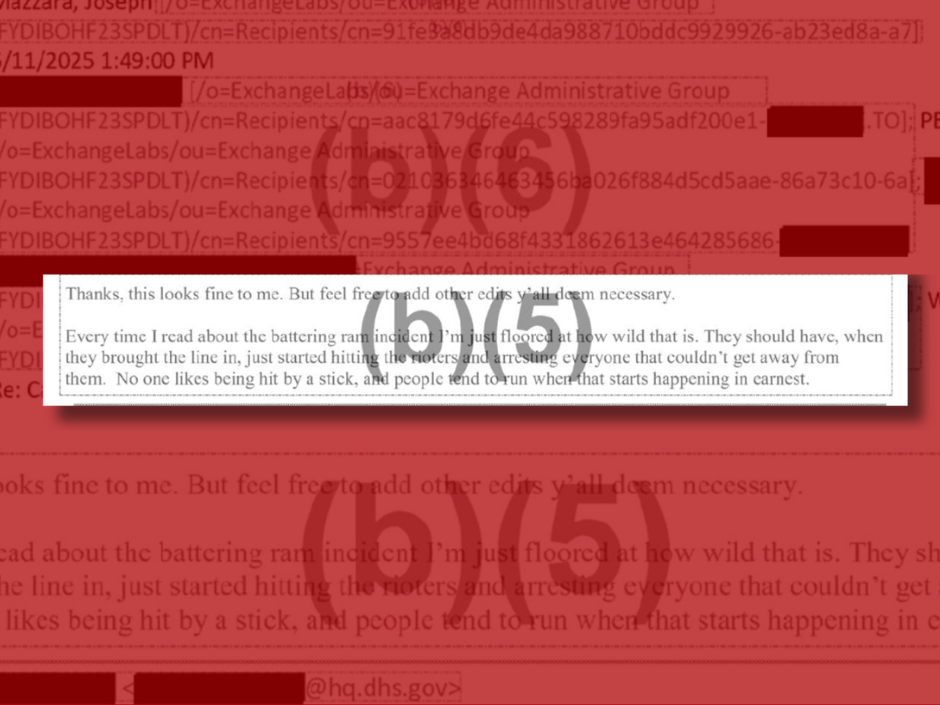
Friday, we released newly-obtained internal Department of Homeland Security (DHS) emails revealing that the agency’s top attorney at the time suggested federal agents in Los Angeles should have “just started hitting” protesters during a 2025 demonstration against Trump’s inhumane immigration policies. The emails, which we obtained through the Freedom of Information Act, were first reported this morning by the Los Angeles Times.
The records show that then–acting DHS General Counsel Joseph Mazzara made the remarks in a June 2025 email exchange among senior officials discussing legal strategy related to the Trump administration’s controversial deployment of National Guard troops to Los Angeles — which a federal court later ruled was illegal. In the same message, Mazzara suggested agents should have arrested “everyone that couldn’t get away,” raising concerns about how senior legal officials viewed both protest activity and the appropriate use of force.
Notably, we obtained two versions of the records. One set indicates that the agency had attempted but failed to properly redact Mazzara’s comments. In the other version, the statement had been successfully redacted, demonstrating that the agency may never have intended for the public to see the remarks.
“Statements like this should alarm anyone who expects federal officials to respect free speech and keep the public safe. When an agency’s most senior lawyer responds to demonstrations by suggesting officers should ‘just start hitting’ people, it raises serious questions about the mindset shaping the government’s legal arguments and decision-making at the highest levels,” said our Executive Director Chioma Chukwu. “It’s no wonder the Trump administration wanted these comments redacted. They reveal a level of hostility toward protesters that is deeply at odds with the government’s obligation to protect civil liberties — and there’s no FOIA exemption that justifies hiding them. These types of attitudes don’t exist in a vacuum; they shape how authority is exercised amid increased tension, especially for immigrant families — many of whom are navigating the Trump administration’s inhumane mass deportation agenda with fear and uncertainty. Rhetoric like this reinforces concerns that aggressive and abusive tactics, rather than rule of law, may guide decisions that directly affect our safety, rights, and ability to participate in public life.”
The release comes amid continued scrutiny of the Trump administration’s use of federal forces in domestic settings and its handling of protest activity, including incidents in which demonstrators were injured or killed during enforcement actions.
In February, we released a tranche of records — obtained through a FOIA request and subsequent lawsuit against Immigration and Customs Enforcement (ICE) — detailing troubling training practices and a more than 300 percent escalation in use-of-force incidents by ICE officers soon after President Trump returned to the White House. The records showed that senior ICE officials were aware as early as March 2025 that officers were using dramatically more force against civilians, months before officers shot and killed two U.S. citizens in Minneapolis.
The same records also revealed that ICE failed to publicly acknowledge the fatal shooting of 23-year-old U.S. citizen Ruben Ray Martinez in South Padre Island, Texas, in March 2025, until we obtained and released the documents. Reporting on the case raised serious questions about discrepancies between ICE’s internal account and what was initially communicated to Martinez’s family, underscoring broader concerns about transparency and whether additional incidents have gone undisclosed.
The materials further show that, even as official training instructed officers that entering a residence generally requires a judicial warrant or consent, instructors were directed to tell cadets that the use of controversial administrative warrants to enter homes was “under review” — aligning with recent whistleblower testimony that officers were given guidance suggesting they could enter homes without a judicial warrant while avoiding formal documentation of that instruction.