How to Read an American Oversight FOIA Code
American Oversight files thousands of FOIA requests every year and receives hundreds of thousands of pages of documents in return. To keep track of it all, we created our own FOIA number system.
Federal agencies assign a sequence of letters and numbers to track records requests and the documents that those requests produce. These federal FOIA number systems, also sometimes known as FOIA numbers, vary from agency to agency. Since we send FOIA requests to every agency, we created our own FOIA number system to keep track of our requests no matter where we sent them.
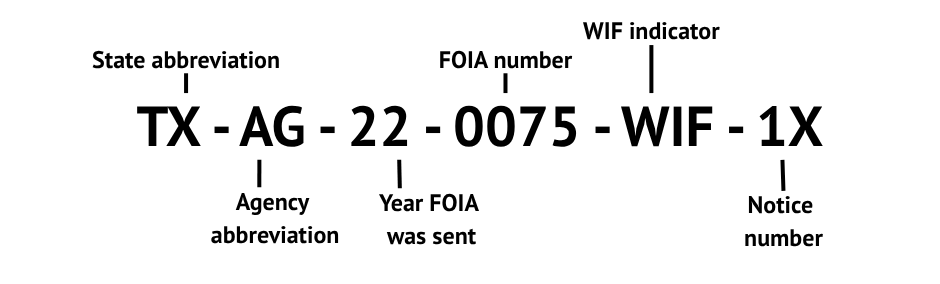
Our FOIA numbers have three parts: The agency abbreviation, the year the FOIA was sent, and a four-digit number corresponding to the order in which the request was sent during the calendar year.

If the request was sent to a state-level agency, we add the state’s two-letter abbreviation to the beginning.
How to Read an American Oversight Production Number
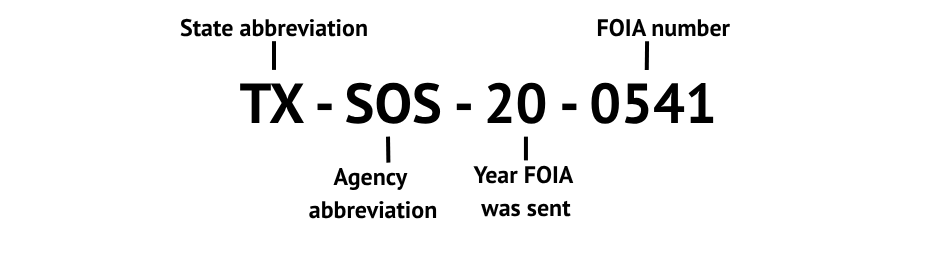
We also create a distinct number called a production number for the documents we receive in response to our records requests.
These production numbers always start with the request’s FOIA number and end with a production letter that indicates what number response it is. The first production is “A,” the second is “B,” and so forth.

Agencies often send sets of records in waves. We might receive some documents a few weeks after filing a request (production A), and then more documents related to the same request a few months later (production B). Production letters help us identify and count the different sets of documents we receive from agencies in response to one FOIA.
There are instances when we don’t receive any records at all. In these cases, an agency will send a notice informing us that no records were responsive to our request. We call these notices No Records Responses (NRRs). NRR numbers include the abbreviation ‘NRR’ and the number order in which they are received followed by an ‘X.’
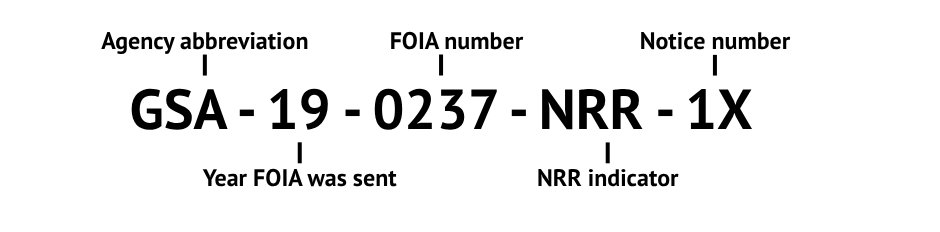
Two other types in our FOIA number system are GLOMARs and WIFs. A GLOMAR notice means that the agency refuses to either confirm or deny the existence of records. A WIF stands for ‘withheld in full’ and indicates that an agency withheld all records because the documents fall under one or more of the nine FOIA exceptions.