
Legal Actions
September 17, 2026
How Trump is profiting off the presidency — and putting his personal wealth over Americans’ best interests.
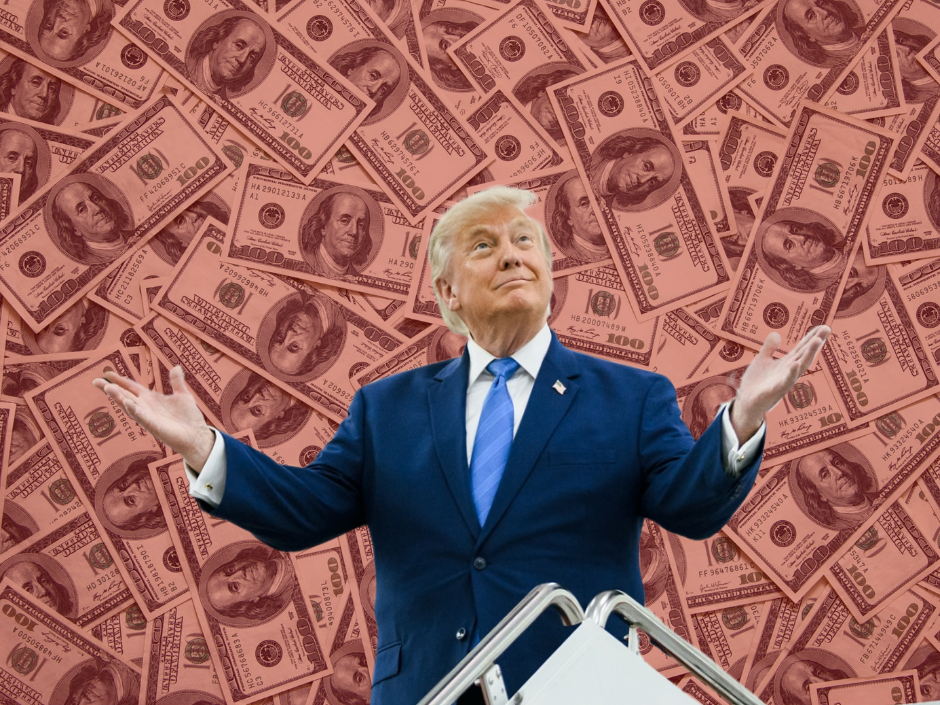
During the first year of President Donald Trump’s second term, he amassed more than $2 billion in new wealth. Trump’s cryptocurrency empire, suspiciously timed investments, high-profile pardons, lawsuit settlements, and building projects raise concerns that Trump is abusing the presidency for profit.
If Trump makes policy decisions to benefit his own pocketbook, Americans will suffer. In fact, while Trump’s personal wealth has ballooned, 95 percent of Americans feel that the U.S. is experiencing an affordability crisis. And 81 percent of Americans believe that corruption in government is increasing their personal costs.
American Oversight has filed Freedom of Information Act (FOIA) requests and, when necessary, sued to shed more light on corruption in the second Trump administration. We want to know what potential conflicts of interest exist, what Trump is promising those who donate to his and his family’s businesses and building projects, and what federal agencies are doing to try to stop Trump’s schemes.
In 2025, Trump pocketed more than $1.4 billion from the Trump Organization’s cryptocurrency businesses. Trump has hosted events that seemingly offered access to him in exchange for investments in these crypto ventures.
Trump’s sons, Eric and Donald Jr., also made a lot of money from cryptocurrency after they founded World Liberty Financial in 2024. A member of the United Arab Emirates royal family purchased a 49 percent stake in the company just days before Trump’s second inauguration. In August 2026, World Liberty Financial received initial approval for a bank charter, a status that could make it easier for businesses and foreign countries to send money toward Trump — and possibly influence his policy decisions.
Trump refused to put his company or his financial portfolio in a blind trust. Subsequently, there have been many instances of the president investing in companies and then using his power to boost those companies. In February 2026, for example, he purchased stock in Boeing shortly before he announced China bought 200 Boeing planes. Trump also has financial interests in many other companies that the administration has or could benefit from, including Nvidia, Paramount, Netflix, Warner Brothers, Palantir, Oracle, and more.
These financial ties raise concerns that Trump could make decisions based on his own financial interests rather than what is best for our national security, economy, or civil liberties.
In May 2025, Trump accepted Qatar’s gift of a Boeing 747-8 jet estimated to be worth as much as $400 million. Trump announced his acceptance of the gift just two weeks after he brokered a deal to build a luxury resort and golf course in Qatar, in part by hiring a company owned by the Qatari government. Trump has indicated he intends for the plane to go to his presidential library upon leaving office — a plan that suggests he sees the plane as a personal trophy rather than a gift to the American people.
In accepting the gift, Trump ignored security concerns and sent a big bill to U.S. taxpayers. Updating the jet to serve as Air Force One — which must allow the president to complete all functions of his office while in the air — required introducing advanced communication and defense systems. While experts estimated it would take years to update the plane to meet the specifications of Air Force One, Trump unveiled the retrofitted plane in June 2026 and flew it to Turkey that July. But as a security precaution, Trump did not return to the U.S. on the plane, raising further questions about whether the quick turnaround had been sufficient.
Since returning to office, President Trump and members of his administration have routinely used Truth Social — the social media platform with strong financial ties to Trump — to announce major government decisions. These announcements have often been made exclusively on the platform, without disseminating the same information anywhere else.
In July 2026, Truth Social rolled out a scheme that gives paying subscribers early access to official government announcements posted on the platform — for a fee of up to $100,000 a month. In an arrangement that critics have called “textbook pay to play” corruption, payments go to Trump Media & Technology Group, the company that owns Truth Social and in which President Trump’s revocable trust is the largest shareholder. In other words, the Trump administration is selling Wall Street faster access to official government announcements that can move the stock market — and financially profiting off of it.
Trump Media launched the Truth API on Aug. 1, 2026, selling real-time, priority access to posts from Truth Social’s ten most-followed accounts — including those of President Trump, White House Deputy Chief of Staff Dan Scavino, the White House Office, Health Secretary Robert F. Kennedy, Jr., Transportation Secretary Sean Duffy, and Federal Bureau of Investigations (FBI) Director Kash Patel.
In the first year of Trump’s second presidency, he pardoned more than 1,500 people, including nearly everyone who was convicted of a crime in connection with the violent January 6 insurrection. By comparison, President Joe Biden pardoned 80 people during his entire presidency.
To meet the Justice Department’s requirements for a pardon, people typically have to wait five years after being released from prison, show remorse and good behavior, and file petitions with the Office of the Pardon Attorney. But 96 percent of those who have received clemency during Trump’s second term have reportedly not met those standards. Instead, many of those pardoned have connections to the president or his close associates. In fact, some people who worked in Trump’s first administration and/or on his campaigns created a firm that lobbies this administration to pardon the firm’s clients.
There are many instances of Trump issuing pardons to people who have recently benefited his or his family’s financial interests. For example, In October 2025, Trump pardoned Binance CEO Changpeng Zhao, who led the cryptocurrency exchange when the company permitted illegal virtual trades and made transactions with terrorist groups. The pardon came shortly after Zhao was involved in a $2 billion investment in World Liberty Financial, Trump’s sons’ cryptocurrency company.
In August 2026, a federal judge dropped criminal charges against India’s wealthiest person, Gautam Adani. The Department of Justice (DOJ) requested the charges be dismissed after Adani pledged to invest $10 billion if his case went away. Adani had also hired one of Trump’s personal attorneys.
In January 2026, Trump sued the Department of the Treasury and the Internal Revenue Service (IRS) for $10 billion, alleging that the federal agencies failed to prevent a leak of Trump’s tax returns in 2017. That May, DOJ announced a settlement for the lawsuit that shielded Trump and his family from IRS investigations in perpetuity, although Attorney General Todd Blanche later claimed that the immunity deal would not cover any future offenses.
The settlement also created a $1.8 billion “anti-weaponization” fund to compensate people who claim they were wrongly investigated by the Biden administration. Critics warned that this money could be used to pay Trump’s allies.
In July 2026, a federal judge threw out the settlement agreement because there was no true controversy in the case, since Trump was both the plaintiff and in control of the agencies that were the defendants. The judge sanctioned some of Trump’s attorneys, writing that they brought a lawsuit “to manipulate the judicial process to pursue benefits unavailable in litigation because the parties were not adverse.” Trump has appealed this ruling.
The next month, Blanche — then the acting attorney general — agreed to have DOJ abandon the fund to secure support for his confirmation to attorney general. In September 2026, however, DOJ also appealed the ruling blocking the fund, raising concerns that the agency will try to revive it.
Trump also sued DOJ and the FBI for up to $230 million in compensation for the agency’s past investigations into potential interference in the 2016 election and Trump’s handling of classified materials. Any deal would present a serious conflict of interest, as Trump is in charge of DOJ and has installed loyalists to lead it.
Initially, the Trump administration and former Attorney General Pam Bondi pledged to provide transparency and answers about convicted sex offender Jeffrey Epstein and DOJ’s files from its related investigation. But by the summer of 2025, Bondi and DOJ backtracked, and seemingly prioritized protecting Trump.
The Wall Street Journal reported that Bondi told Trump in May 2025 that his name appeared in the Epstein files. On July 15, DOJ announced it would not release more files. Just days later, ranking member of the Senate Judiciary Committee Dick Durbin published a letter claiming that FBI agents reviewing the Epstein files were told to “flag” mentions of Trump. Documents released by DOJ this year indicate that FBI agents did receive these instructions.
In November 2025, Congress passed and Trump signed into law the Epstein Files Transparency Act, which required DOJ to release its investigative files on Epstein to the public by December 19, 2025. DOJ failed to meet this deadline, but in January 2026 it released more than three million pages that contained more than 1,000 mentions of Donald Trump. However, later reporting and subsequent releases revealed that documents with accusations against Trump had been withheld.
In July 2025, Trump announced the construction of a ballroom at the White House. While Trump initially claimed the ballroom wouldn’t “interfere with the current building,” the East Wing was torn down in October 2025. Trump has said that the ballroom will be a monument to himself.
Federal law requires the National Capital Planning Commission (NCPC) to review and approve any changes to the White House. These approvals commonly take years. In July 2025, Trump placed three allies on the NCPC. In April 2026, the NCPC voted to approve the project. Trump also fired every member of the U.S. Commission of Fine Arts — which is tasked with advising on federal monuments and buildings — in October 2025.
Trump has solicited hundreds of millions of dollars from corporations and individuals to fund the ballroom’s construction, raising concerns that they were promised something in return for their donations. While Trump has not disclosed a full list of donors, he previously released a list of 37 donors that includes Amazon, Meta, Lockheed Martin, Apple, and Microsoft. There are also questions as to how much tax payers are funding the construction of the ballroom. In August 2026, the Washington Post reported that the federal government planned to spend close to $1 billion on the ballroom and other White House building plans.
The National Trust for Historic Preservation filed a lawsuit in December 2025, alleging that the ballroom’s construction had not complied with legal guidelines. This lawsuit is still pending and has at times produced temporary injunctions that halted construction. As of August 2026, construction on the ballroom is proceeding while the Supreme Court considers the case.
Trump awarded a no-bid contract to Atlantic Industrial Coatings — which had previously completed work at properties his business owns — to renovate the Lincoln Memorial Reflecting Pool. His administration justified the no-bid process by claiming the work needed to be completed in time for the 250th anniversary celebrations in the capital in July 2026.
Shortly after the work was completed that June, paint began to peel off and algae bloomed in the water. The administration did not seek new bids to fix the inadequate work from Atlantic Industrial Coatings, but instead continued to use the company.
The president blamed vandals for the peeling paint, leading to several arrests including former Olympian David Hearne. The U.S. Attorney’s Office in Washington, D.C. dropped the charges, claiming that damage was the result of a botched installation instead of vandalism. Documents obtained by the New York Times showed that the contractor acknowledged the issues were the result of “human oversight” and not vandalism.
Miami Dade College donated $67 million in property for Trump’s future presidential library — a huge gift from a public college. The donation raises questions about what, if anything, the local or state government might have been promised in return for the prime real estate.
Major corporations such as Meta, X, and ABC News all reportedly promised to make large donations to the library as part of agreements made to settle lawsuits brought by Trump. Yet the fund established to support the library was dissolved without any details about where the money that had been raised went.
The plans for a Trump presidential library have also raised concerns because Trump has claimed it will be a hotel. Presidential libraries have typically been run by an associated nonprofit, raising questions about how a hotel could be a nonprofit as well as how a hotel would fulfill the library’s charter of operating for historical preservation and educational purposes.
In 2016, Congress created a bipartisan commission called the U.S. Semiquincentennial Commission to plan the country’s 250th anniversary celebration. In July 2025, it appropriated $150 million in funding for the events that would be distributed by the Interior Department. It seemed that this money would go to America250, the nonprofit associated with the bipartisan commission.
But in December 2025, Trump announced Freedom 250, a separate nonprofit housed inside the National Park Foundation, a congressionally-chartered nonprofit that fundraises for the National Park Service. Subsequently, large chunks of taxpayer funds went to Freedom 250 instead of America250. For example, the Interior Department reportedly gave at least $68 million of taxpayer money to the National Park Foundation and earmarked it for “significant events to commemorate the nation’s semiquincentennial” and “A250 events.” Prior to the creation of Freedom 250, the National Park Foundation had received less than $8 million in federal grant money since 2009.
Trump appears to be using Freedom 250 to sell access to himself. The New York Times obtained a Freedom 250 donor packet that suggested individuals who donated $1 million or more would receive an invite to a private reception with Trump. Freedom 250 CEO Keith Krach encouraged world leaders to donate at the World Economic Forum in Davos earlier this year. Meanwhile, American embassies and consulates have been meeting with global executives to solicit donations to Freedom 250. These campaigns have raised concerns that Trump could be promising favorable treatment to companies that give money.
Ethics rules and good-governance measures are in place to prevent corruption and ensure our leaders serve the American people instead of their self-interest. This is especially important in the current economic climate: More than half of Americans say they are struggling to afford gas and groceries, and 95 percent say the U.S. is experiencing an affordability crisis. This isn’t just an issue of perception: The Urban Institute found that 49 percent of Americans live in families that do not have the resources to cover the true cost of living.
Trump should make key economic and foreign policy decisions based on what will benefit Americans and keep them safe. If the president instead makes these decisions based on what will most enrich himself, it will put Americans’ wellbeing at risk.
American Oversight is using Freedom of Information Act requests and litigation to investigate corruption in the second Trump administration.
Along with the Freedom of the Press Foundation, we sued the Trump administration for the legal opinions regarding the jet from Qatar. To investigate how the Trump administration handled the Epstein files, we sued for training materials and instructions related to DOJ’s review of the files. We also sued for records of any interviews conducted with Trump as part of DOJ’s investigation into Epstein.
In September 2026, American Oversight and Campaign for Accountability sued President Trump and several administration officials to put a stop to the pay-to-play Truth Social scheme. The suit argues that we — along with other watchdogs, journalists, and the public — receive delayed access to official government information, compared to paying subscribers. This undermines our ability to track and report on the administration.
We have also filed dozens of FOIA requests to shed light on how Trump might be abusing his power, what guidance exists to try to prevent those abuses, and what — if any — actions the Trump administration has taken to stop it. We filed FOIA requests asking DOJ and the Department of Defense for communications about the jet from Qatar and with Qatari officials, as well as costs to prepare the jet for use as Air Force One. We asked the IRS, DOJ, U.S. Patent and Trademark Office, Securities and Exchange Commission, and the Commodities and Futures Trading Commission for communications with and about World Liberty Financial.
We asked the Treasury, the IRS, and DOJ for the legal justifications for Trump’s IRS immunity deal, as well as the full settlement agreement, policies and instructions regarding the $1.776 billion fund, and related communications. We filed FOIA requests for any ethical deliberations, legal justifications, and/or recusal documents regarding the Trump administration’s lawsuits against DOJ and the FBI.
To investigate the Trump Presidential Library, we filed public records requests with the Florida Governor’s Office, the Florida Attorney General, and the Florida Department of Environmental Protection’s Division of State Lands for their external communications with the White House, Trump campaign, and trustees of the library. These records could help us understand how Florida officials have discussed the donation and future plans for the library.
To learn more about who is funding the White House ballroom, we requested communications with or about donors, as well as records of the forms donors fill out to pledge money. We also sent FOIA requests to investigate the administration’s claims that the ballroom must be built for national security purposes. We asked the U.S. Secret Service, DOJ, and the National Park Service for relevant communications, contracting documents, and final recommendations about the ballroom.
We sent FOIA requests to the Interior Department, the National Park Service, and the Department of State, for records that could show how taxpayer dollars and corporate or foreign donations are funding Freedom 250 events and if there is any political or partisan bias to 250th related events. We also requested communications regarding the celebrations, lists of donors, ethics and legal opinions regarding Freedom 250, and dissent memorandum.
Finally, we sent FOIA requests to the Interior Department and National Park Service for contract documents and communications related to the failing paint and algae bloom at the Reflecting Pool. We also asked DOJ, the White House, and the U.S. Marshals Service for directives related to policing the area.
We will continue to expose and fight against President Trump’s abuse of power to line his and his families’ pockets at the expense of everyday Americans.