
Immigration Detention Centers
What we know about the conditions and who is profiting — and what we still need to find out.
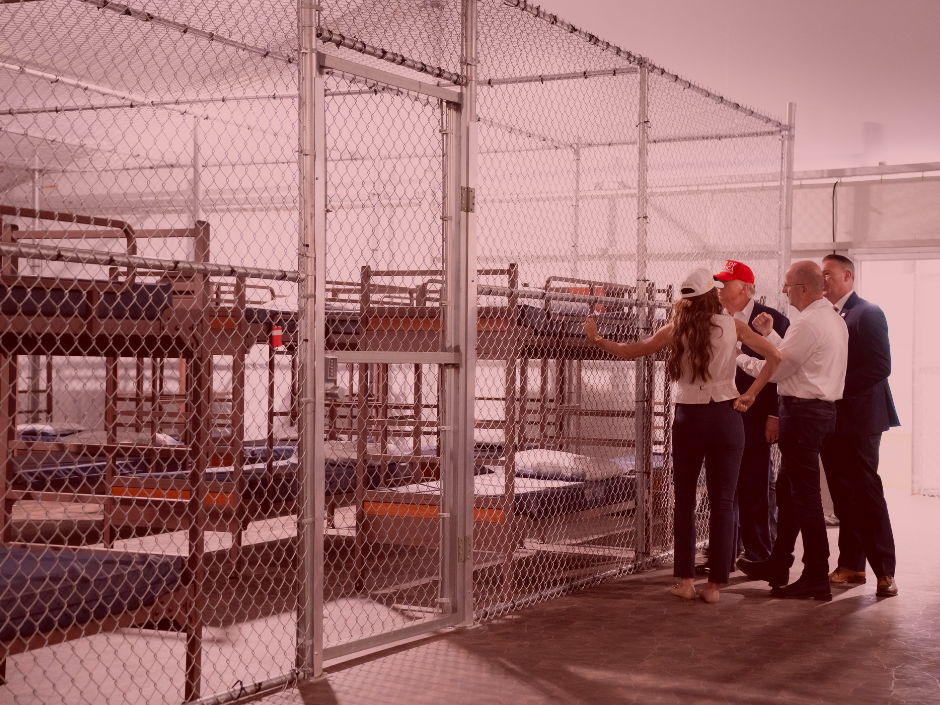
In the first year of President Donald Trump’s second administration, the number of people in Immigration and Customs Enforcement (ICE) detention skyrocketed as the administration pushed towards its goal of deporting 1 million people per year. Non-United States citizens being held in detention at a given time increased by 75 percent, surpassing 70,000 people, and ICE nearly doubled the number of detention sites it utilizes.
Oversight of these facilities — including everything from the conditions people are being held in, their legal rights, and who is making money off of this crisis — has been an ongoing challenge.
What we know
Within the first week of Trump’s second term, ICE was directed to arrest 1,200 to 1,500 people daily. ICE exceeded the capacity of its existing detention facilities within three weeks. In April 2025, the administration announced plans to triple ICE’s detention capacity to detain an additional 84,000 people. In January 2026, internal documents revealed that the administration planned to spend $38 billion to increase detention capacity by 92,000 beds.
Until recently, the majority of ICE detention facilities were privately operated — and people in detention reportedly faced concerning conditions in these locations. Now, the huge influx of funding for ICE is allowing the agency to increase its capacity by renting and purchasing facilities outright. The agency’s plan initially focused on converting commercial warehouses into detention centers. These warehouses were not designed to house humans and often have poor ventilation and temperature control, as well as inadequate sewage and sanitation systems for large populations. As of August 2026, ICE is trying to offload ten of the warehouses it purchased.
The Trump administration has pursued other extreme measures to detain more people. Some plans included holding people at the Guantánamo Bay military prison and building more open air tent camps. Trump has also announced plans to detain immigrants at military bases, building a nationwide network of facilities that includes a “deportation hub” in Fort Bliss, Texas, intended to hold up to 10,000 people.
State governments have also authorized new detention facilities. In June 2025, Florida Gov. Ron DeSantis’ administration announced plans to turn an airfield in the Everglades into a detention center cruelly named “Alligator Alcatraz.” Rolling Stone reported that two of the firms hired to build the detention facility had made significant donations to one or both of the DeSantis and Trump campaigns. The state has awarded $245 million to private contractors to help run the facility.
Other state governments have followed suit. Louisiana is housing detainees at its notorious maximum-security Angola prison. Indiana and Nebrasksa are also using their state prisons to imprison immigrants. At the same time, ICE is reopening prisons that were shut down and repurposing them as detention facilities.
As ICE’s footprint expands across the country, the Trump administration has made it harder to know what is happening inside of these facilities. In 2026, it closed the Office of Immigration Detention Ombudsman, after gutting the internal watchdog in 2025. In summer 2025, the Department of Homeland Security (DHS) barred members of Congress from access to facilities and information needed to perform their legally authorized oversight duties. The administration mandated a seven-day waiting period and prohibited access to field offices where people are being detained, despite a federal law that prevents these restrictions.
Why this matters
Many reports out of ICE’s mass detention facilities indicate people are being held in horrifying conditions. More than 50 people have died in immigration detention since the start of 2025, and our research indicates that many of these deaths were likely preventable.
People are being held without access to their basic needs, including beds, showers, adequate food, and medical care. At Camp East Montana, the largest facility in the country, there are reports of excessive force, including an extrajudicial killing. Immigrants detained in Florida were reportedly only allowed water at mealtimes and have been punished with prolonged sun and mosquito exposure. Nursing mothers have been separated from their babies and pregnant people have suffered miscarriages after failing to receive adequate medical care. Children were infected with measles at the Dilley Immigration Processing Center, the largest detention facility for children.
The Trump administration’s rush to increase detention capacity has likely made these conditions worse. Trump’s “border czar” Tom Homan said in February 2025 that the administration was working to reduce the number of required federal inspections and to lower detention standards so that more county sheriffs could detain people on behalf of ICE.
While people being held in detention suffer, some private companies are cashing in. Damon Hininger, then the CEO of private prison company CoreCivic, said during a February 2025 earnings call: “I’ve worked at CoreCivic for 32 years, and this is truly one of the most exciting periods of my career. We anticipate significant growth opportunities, perhaps the most significant growth in our company’s history over the next several years.” The GEO Group, one of the largest private prison companies in the U.S., signed four new contracts to imprison immigrants in 2025. Its profits soared to $254 million that year — nearly a seven-fold increase from 2024.
Private prisons have been found to perpetuate significant abuses against inmates, as companies are motivated to cut costs associated with care and turn detention into profit. In 2025, then-acting ICE Director Todd Lyons said of mass deportation efforts, “We need to get better at treating this like a business, like [Amazon] Prime, but with human beings.”
What we’re doing
American Oversight is fighting to ensure lawmakers can conduct unannounced oversight visits at ICE detention facilities and using public records requests and litigation to investigate mass detention.
Securing members of Congress’s right to conduct oversight visits
In July 2025, we filed suit with Democracy Forward on behalf of 13 members of Congress, challenging the Trump administration’s unlawful obstruction of congressional oversight at ICE facilities. In December, a federal court temporarily stopped this policy, restoring Congress’s ability to conduct real-time oversight of how DHS and ICE detain people.
Following the murder of Renée Good by an ICE agent in January 2026, then-DHS Secretary Kristi Noem secretly reinstated the requirement for advance notice of congressional oversight of detention facilities, through a previously undisclosed memorandum. The memo came to light only after multiple members of Congress were denied entry to an ICE facility in Minnesota despite presenting a valid court order. We went back to court and in February a judge granted our temporary restraining order, reinstating 13 members of Congress’ ability to perform unannounced oversight of ICE detention facilities.
Uncovering abuse through Freedom of Information Act (FOIA) requests and litigation
Through a FOIA lawsuit, we obtained ICE contractors’ shift reports, texts from ICE leadership, updates on a chaplain’s program, and official detention policies from the facility in Guantánamo Bay. In November 2025, the New York Times published a story based on these records that highlighted how the administration rushed to set up the detention program that spring. The documents revealed that most of the people detained at Guantánamo were considered a low risk to public safety, that detainees protested their confinement and/or conditions, and that ICE was unprepared to house detainees at the military base.
We have filed many more FOIA requests for records related to mass detention. Here is some of what we’re seeking:
- Private prison contracts: In response to the Trump administration expanding contracts with private prison companies to increase immigration detention capacity, we requested communications with and about private prison contractors and records regarding plans to renovate or update existing facilities.
- ICE Alternatives to Detention (ATD) policies: ICE has announced plans to expand ATD programs that use electronic monitoring technologies such as GPS to surveil people outside of detention facilities. We sent requests to ICE for records related to current and changing ATD policies, as well as communications containing key terms about ATD programs.
- DHS oversight offices shutdowns: The Trump administration recently dismantled DHS’s Office for Civil Rights and Civil Liberties, Office of the Immigration Detention Ombudsman, and Office of the Citizenship and Immigration Services Ombudsman. These offices were responsible for providing oversight of various aspects of immigration work at DHS, with the Office of the Immigration Detention Ombudsman particularly focusing on investigating abuse in detention facilities. In response, we sent requests to DHS, ICE, and Customs and Border Protection (CBP) for records on the shutdowns and their impact.
- Legal service provider detention facility access: Legal service providers have shared that funding freezes have prevented them from accessing clients detained by ICE. We sent requests to the Justice Department and ICE seeking directives, communications, and complaints regarding legal service providers’ access to detention facilities.
- Detention no-release policies: Immigrant advocates have heard reports from intelligence officials that there is a “no-release” policy in place for Uzbekistan and adjacent countries. Uzbek nationals are reportedly systematically denied release even after their credible fear screening. We asked DHS, ICE, and CBP for all “no-release” policies and related communications.
- Louisiana contracts with ICE and CBP: We sent requests for contracts and communications regarding the reported use of a warehouse in New Orleans for immigration enforcement and detention.
- ICE county detention records: We sent requests to county detention facilities in Florida, Kentucky, Louisiana, Massachusetts, Minnesota, Nevada, Oklahoma, Pennsylvania, and Wisconsin for complaints filed by detainees, information about the number of detainees who have sought medical treatment, and information about how facilities handle such records requests.
- Florida’s Everglade detention facility records: We’ve sent public records requests to multiple agencies for related communications, cost records, and facility inspection reports.
- Other state-run detention facility requests: We requested records from the Georgia and South Carolina governors’ offices — states reportedly considering detention sites — seeking internal and external communications with the White House, DHS, and ICE.
- New York detention center conditions: We sent requests to ICE and the New York Enforcement and Removal Operations field office for communications, inspection reports, policies, and logs related to the conditions at the ICE detention center at 26 Federal Plaza in New York City.
- Baltimore ICE temporary detention facilities conditions: There were specific reports on poor quality facilities and treatment of ICE detainees at ICE’s Baltimore office. We submitted a request for key term communications, population data, inspection reports, and policies regarding recent detainee detention in Baltimore.