
Legal Actions
October 28, 2025
Complaint: American Oversight v. DHS and FEMA — Top Officials’ Texts Regarding Controversial Military Actions
Federal
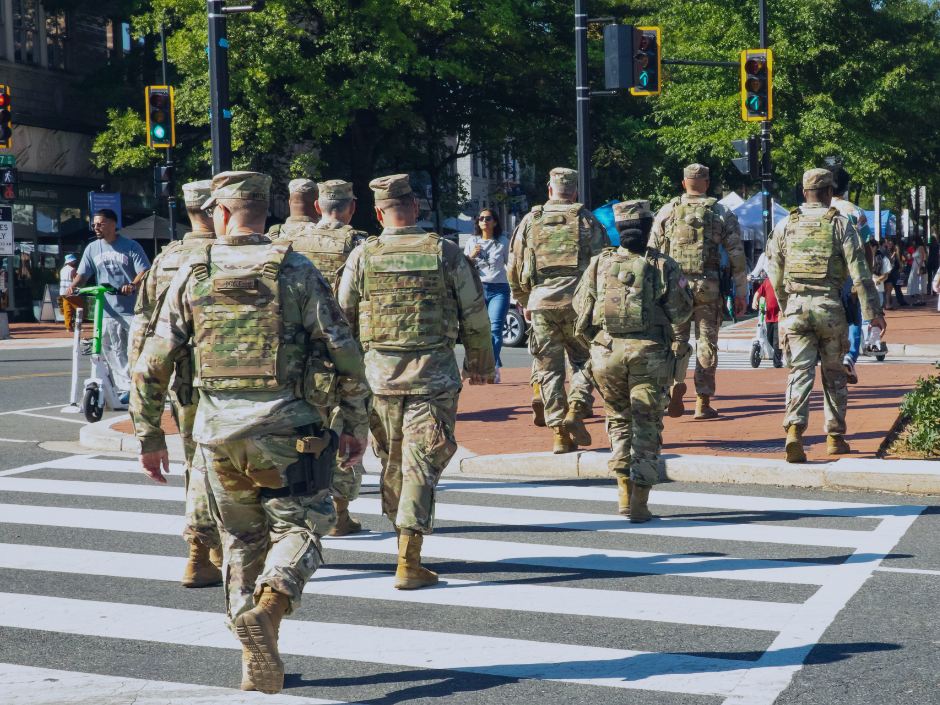
The Trump administration has authorized the National Guard to occupy six American cities — often over the objections of local and state leaders. Successful legal challenges shortened or minimized troop deployments, and the Trump administration withdrew all remaining federalized troops from Los Angeles, Chicago, and Portland, Oregon, in January 2026. Some National Guard members remain under unique agreements in Memphis, Tennessee, and Washington, D.C.
The stakes are chilling: Trump used a largely peaceful protest in Los Angeles to seize emergency presidential powers and then extended that power to occupy multiple American cities. That is not how a healthy democracy functions: Dissent and protest are a form of speech, and are not supposed to be shut down by the military.
In early June 2025, thousands of Los Angeles residents turned out to protest the Trump administration’s immigration raids and deportations. Despite local and state authorities stating that the protests were manageable, on June 7, Trump ordered 2,000 National Guard soldiers to Los Angeles over the objections of Mayor Karen Bass and California Gov. Gavin Newsom. This was the first time a president activated a state’s National Guard without the request of a governor since 1965.
Trump’s memorandum authorizing the deployment cited 10 U.S.C. § 12406, or Title 10, which permits the president to call federalized troops into service in situations of invasion, rebellion, or when regular forces are insufficient to execute the law. Legal experts warned that the deployment was illegal under the Posse Comitatus Act, which prohibits active-duty military from conducting law enforcement activities unless expressly authorized by another law.
On June 9, 2025, California filed a lawsuit against the administration, claiming the deployment was an illegal and unconstitutional incursion on state authority. In response, Trump — who earlier that day had stated, “I think we have it very well under control” — deployed 700 Marines and an additional 2,000 National Guard members to the city. By the end of July, most of the federalized troops had demobilized or started the process of departing.
In September, a federal judge found that the deployment violated the Posse Comitatus Act. All remaining federal troops left Los Angeles in December following a court order that described the occupation as “profoundly un-American.”
In August 2025, Trump issued an executive order declaring a “crime emergency” in the nation’s capital, claiming crime was “out of control” — despite the fact that FBI data showed violent crime in D.C. had dropped significantly prior to the deployment.
For the first time in history, a president invoked Section 740 of the Home Rule Act to place the Metropolitan Police Department (MPD) under the authority of the U.S. Attorney General. Trump also deployed more than 2,000 National Guard troops to the city and ordered a surge of federal law enforcement officers. Eleven states sent National Guard members to support the occupation. These states contained at least 10 cities with higher crime rates than the capital.
In September 2025, D.C.’s attorney general sued the administration to halt the occupation. A judge found that the National Guard deployment was unlawful and ordered troops to leave in November, but multiple courts have stayed (paused) this order, so it is not in effect as of March 2026.
While the federalization of MPD ended in September 2025, thousands of troops remain in D.C. and could stay until the end of the Trump administration in January 2029.
In September 2025, Trump signed an executive memorandum, alongside Tennessee Gov. Bill Lee, authorizing the deployment of federal troops and law enforcement officers to Memphis to combat crime. While the Memphis mission was modeled on the Los Angeles and D.C. federal deployments, it significantly differed because Tennessee’s governor requested the troops’ presence.
Federal law enforcement officers from 13 U.S. agencies and 219 troops arrived in Memphis that month and were actively patrolling the city by October. In November 2025, the National Guard deployment grew to roughly 350 troops.
As of April 2026, troops remain in Memphis. While their presence is funded by the federal government, the Tennessee governor oversees their activities.
In late September 2025, Trump announced on social media that he had ordered 200 National Guard members to Portland, Ore., after Fox News showed B-roll footage of 2020 protests. Portland Mayor Keith Wilson and journalists speculated that Trump did not understand the footage was old, and that he believed there were ongoing widespread protests in the city. As in Los Angeles, Trump used Title 10 to authorize the mobilization, despite objections from local officials.
Although troops were never deployed to Portland, National Guard members were on standby outside the city. In January 2026, Trump withdrew the deployment and 100 troops returned to Fort Bliss in El Paso, Texas.
The Trump administration began Operation Midway Blitz in and around Chicago, Ill., on Sept. 8, 2025, with the stated goal of increasing deportations and reducing crime. Customs and Border Protection (CBP) and Immigration and Customs Enforcement (ICE) agents patrolled areas of downtown Chicago starting on Sept. 28. Trump authorized the National Guard’s presence in Chicago in early October and hundreds of troops were reportedly dispatched to the city. Like in Los Angeles and Portland, local and state officials did not want the National Guard in their city, but Trump cited Title 10 to override their authority.
The city of Chicago and state of Illinois sued the Trump administration over the National Guard’s deployment in October 2025. That same month, three judges blocked the deployment of the National Guard. Most troops that had been dispatched to the area were sent back home starting in November.
The Supreme Court issued a temporary order preventing Trump from sending troops to Chicago in December, finding that the circumstances did not warrant the federalization of the National Guard. Subsequently, on Dec. 31, 2025, Trump announced that he would stop his attempt to deploy troops to Chicago, Portland, and LA.
Louisiana Gov. Jeff Landry requested troops in September 2025, claiming crime rates in New Orleans necessitated federal intervention. In December, Trump announced that he would send the National Guard and deploy 250 Border Patrol agents to the city. Later that month, Trump deployed an additional 350 National Guard members to the city.
Federal troops remained in New Orleans as of April 2026, even as the Trump administration pulled back troops from other cities. Like in Memphis, the National Guard troops are overseen by the state’s governor while the federal government funds the operation.
The deployment of federal troops to American cities has demonstrated Trump’s willingness to manufacture crises as a way to expand his presidential powers.
Trump’s memo federalizing the National Guard troops to Los Angeles cited Title 10, a law that permits the president to federalize troops in situations of invasion or rebellion. But protesters’ clashes with police were confined to a small area and did not constitute a rebellion or invasion. Trump used the same justification for deployments to Portland and Chicago, and he weighed similar action in New York City and Baltimore, Md., as well as in San Francisco and Oakland, Calif. Trump also threatened to invoke the Insurrection Act in Minneapolis, Minn., which would grant him even more emergency powers to use military force against civilians.
In other words, Americans protested a government action — a right guaranteed to them by the First Amendment — and Trump responded by deploying the military.
It is also important to note that Trump’s actions were often against the will of state and local governments. By calling the National Guard into cities that did not want them, the administration violated long-established laws designed to prevent an authoritarian takeover by the federal government, such as the Posse Comitatus Act. Law enforcement happens at the state and local level for a reason: It decentralizes power. Experts warn that the repeated use of military forces in non-emergency situations weakens democratic norms and creates openings for authoritarian abuse of power.
The consequences are clear: In Washington, D.C., National Guard documents show that residents described troops’ presence as “leveraging fear” rather than providing security, fueling a sense of shame among veterans and driving a wedge between communities and those who serve them. In Los Angeles, Guard members and Marines confided to their families that they felt like political pawns, and many questioned why their service was being used against their own communities.
The deployments are also very costly. The Congressional Budget Office estimated in January 2026 that the Los Angeles, Portland, Memphis, Chicago, and D.C. deployments cost $496 million between June and December 2025. A Senate Homeland Security Committee minority staff report found that the D.C. deployment cost an estimated $332 million between August 2025 and February 2026.
We have obtained records that shed light on the deployments in D.C. and Memphis. Records from the D.C. mayor’s office reveal that it estimated 11.5 percent fewer people commuted to D.C. in the two weeks following the National Guard’s deployment. Visits by non-residents dropped 22 percent for this same time period.
Records we obtained from the Tennessee National Guard show that there was at least some initial confusion about the deployment in Memphis. “By now, I am certain you are all wondering what the mission in Memphis will look like,” Tennessee Army National Guard Assistant Adjutant General Steven Turner wrote in an email in September 2025. “To be honest, I am too.” Turner explained that the Tennessee National Guard would support federal agencies in the city, modeled off of states’ National Guard deployments in D.C.
Americans have a right to know who authorized these deployments, whether local governments cooperated, and what orders and training occupying troops have received.
We’ve filed many Freedom of Information Act (FOIA) requests to investigate, focusing on places that opposed the National Guard’s presence. When we have not received answers, we’ve sued.
We filed FOIA requests in April 2025 for records regarding the military’s involvement in immigrant enforcement, in anticipation of the administration’s eventual use of the military. After Trump deployed the National Guard to Los Angeles, we sued the administration for failing to release these records.
We also filed nearly three dozen expedited FOIA and California Public Records Act requests with federal, state, and local agencies, including the U.S. Departments of Justice (DOJ), Defense (DOD), and Homeland Security (DHS); ICE; the U.S. Northern Command; the National Guard Bureau (NGB); the California Military Department; and the U.S. Marine Corps. Our investigation seeks communications regarding the deployment and related protests, formal directives and policies regarding the use of military force for protest response, and meeting records and internal dissent communications. Through these records requests, we’re seeking to learn whether the federal government acted lawfully and transparently — or inappropriately escalated federal force to chill dissent against Trump’s immigration policies.
In October 2025, we sued DHS and the Federal Emergency Management Agency (FEMA) for failing to respond to our June requests for text messages and other communications from then-Secretary Kristi Noem and other senior officials related to the Los Angeles deployment. The records could reveal the circumstances in which federal resources were mobilized in response to domestic demonstrations, and whether DHS officials coordinated politically motivated actions outside their lawful authority.
In September 2025, we filed two dozen FOIA requests for records related to Trump’s memorandum authorizing the deployment of National Guard troops and federal law enforcement officials to Memphis. We asked the DOD, U.S. Northern Command, DOJ, NGB, CBP, and the Tennessee National Guard for communications, directives, itineraries, and legal opinions regarding this deployment.
In August 2025, we submitted multiple FOIA requests seeking the expedited release of records related to the federal takeover of the capital, including communications, documents regarding the forced removal of homeless encampments, and correspondence between federal officials and the District government. That same month, we sued the Department of the Interior and the National Park Service for failing to expedite the release of these records.
We expanded our investigation in September, after multiple states sent their National Guard units into the city. To understand how the administration escalated the takeover of Washington, D.C., we sent requests to eight agencies for communications, directives, meeting materials, and call logs. Additionally, we sent requests to the MPD for their communications and directives regarding D.C. home rule and collaborating with federal immigration enforcement officials, as well as to the Mississippi, South Carolina, Ohio, and West Virginia Governor’s Offices, for communications regarding the National Guard deployments to Washington.
Finally, after D.C. Mayor Muriel Bowser issued an executive order requiring indefinite coordination between the city and federal law enforcement in September 2025, we sent requests to Bowser’s office for external communications and meeting materials with the White House and Trump administration officials. These requests probe the White House’s involvement in Bowser’s executive order. We also sent requests to the D.C. Office of the Deputy Mayor for Planning and Economic Development for economic impact assessments and communications about the National Guard deployment.
After Trump authorized the National Guard to deploy to Chicago, we asked the DOD, U.S. Northern Command, NGB, DOJ, Executive Office for United States Attorneys, ICE, CBP, and National Guards in Illinois and Texas for records regarding these deployments. The requested documents include communications containing key terms or with city officials and the White House, as well as legal opinions, conscientious objector paperwork, and time tracking records for troops.
We sent requests to the U.S. Attorney for the District of Oregon, NGB, Oregon National Guard, and California National Guard for communications, directives, and training materials regarding the deployment to Portland.
In October, the Pentagon reportedly ordered thousands of specialized National Guard personnel to complete civil unrest mission training in the near future — a troubling sign that the Trump administration planned to expand the presence of the military in American cities.
We asked the NGB and DOD for civil unrest training materials, key term communications regarding the quick reaction forces, estimated projected budgets and expenditures, and final plans for handling potential pushback from state governors.