
The Trump Administration Is Using a Rare Legal Trick to Avoid Damaging Facts
Government lawyers are asking courts to strike text from our lawsuits related to issues that have drawn public scrutiny of the Trump administration.
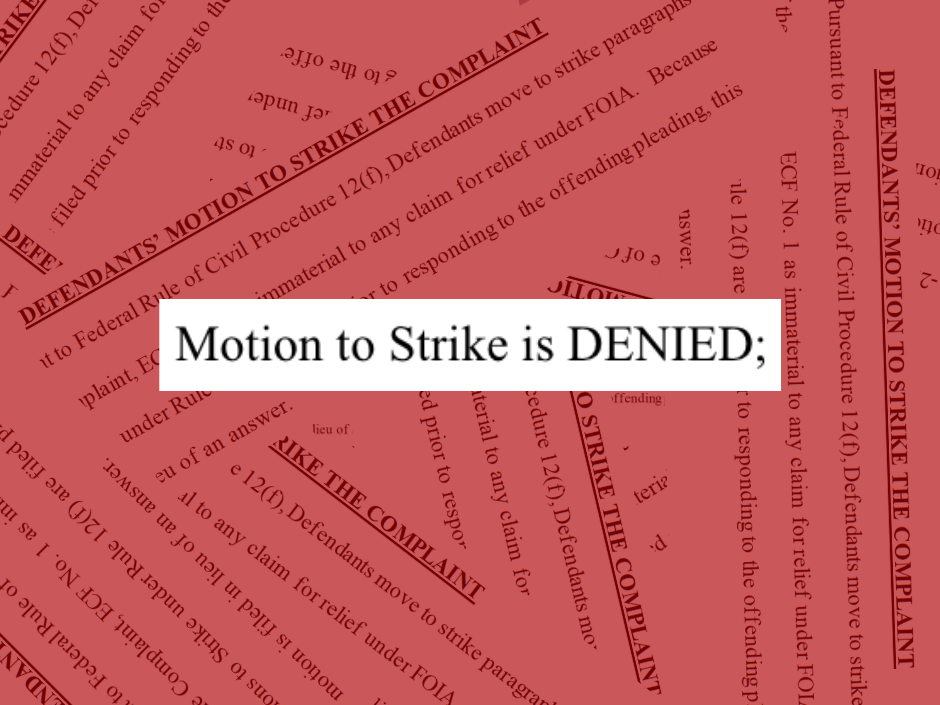
The Trump administration has recently filed motions to strike, or requests that a judge delete sections of lawsuits, in four of American Oversight’s Freedom of Information Act (FOIA) lawsuits. This is an unusual tactic, and seems to be part of an effort to delay cases and avoid admitting damaging facts in court.
What are Trump administration lawyers doing?
If the government does not respond to a FOIA request, we often take them to court to get the information we are looking for. Often, our lawsuits begin with a section that includes key background facts about the records we are requesting, to explain why it is important for the public to have access to them.
In four of our recent cases — lawsuits that are seeking records related to the $400 million jet Qatar gifted to Donald Trump, the whistleblower allegations that a top official defied court orders to deport a planeful of people to a prison in El Salvador, the FBI review of Jeffrey Epstein files, and interviews with Trump in the Epstein investigation — the government’s attorneys have asked judges to delete the background facts in our lawsuits. In these cases, they claim this information is “irrelevant” and “scandalous” — even though the information we include is often from government sources.
Here’s a sampling of the information that the administration has attempted to strike:
- A Truth Social post by President Donald Trump about the jet gifted by Qatar
- A social media post by FBI Director Kash Patel about transparency at the agency
- A news article that directly quotes Attorney General Pam Bondi discussing the Department of Justice (DOJ) review of the Epstein files
- A memo from the DOJ and the FBI about the Epstein file review
- Citations to news articles from the PBS Newshour, CNN, ABC News, the Associated Press, the Washington Post, NPR, Bloomberg Law, Newsweek, the Wall Street Journal, the New York Times, and New York Magazine, among others.
Why is this so unusual?
Motions to strike are rarely used and judges typically don’t like them.
According to the Federal Rule of Civil Procedure 12(f), a judge can remove “an insufficient defense or any redundant, immaterial, impertinent, or scandalous matter” in a lawsuit. But even the Trump administration admits in its legal briefings that “motions to strike are generally disfavored.”
Typically, it’s more important for the lawyers and judge to focus on whether the government has violated the law in not releasing requested records. A motion to strike is considered a delay tactic that interferes with that work.
Motions to strike are also considered extreme because they address a relatively minor issue with a “drastic remedy:” permanently deleting entire portions of a lawsuit.
The administration’s arguments for removing text are weak.
The administration’s lawyers have claimed that our complaints include “incendiary” allegations, but the language the administration has attempted to strike includes direct quotes from administration officials and reporting from reputable outlets.
We include this background information in our complaints because it is relevant to the case. This information can help us demonstrate why we need the documents as fast as possible, if the government’s search for records was sufficient, why the government’s justification for withholding documents is wrong, and why the government should have to pay our attorney fees.
So far, three federal judges already agree with us. In our lawsuit for records related to the FBI’s review of the Epstein files, Judge James Boasberg found that we “largely quote[d] administration officials” and that is “hardly scandalous or prejudicial.” Judge Boasberg ruled that it was best to keep the case moving by not requiring us to delete anything from our lawsuit. In our lawsuit for any interviews conducted with Trump as part of the Epstein investigation, Judge Timothy Kelly denied the motion to strike. We mostly “simply allege[d] that administration officials made certain publicly reported statements or took certain publicly reported actions,” he wrote. “And the allegations themselves are hardly scandalous or prejudicial.” And in our lawsuit for records related to deportations to El Salvador, Judge Christopher R. Cooper denied the government’s motion to strike and cited Judge Kelly’s previous decision.
Why are government lawyers using this tactic?
The motions to strike are an attempt to avoid admitting damaging facts in court.
As part of a court case, defense lawyers are required to say whether the allegations in a lawsuit are true. That can include confirming or denying the information we include in our complaint.
In other words, a government attorney could be asked to confirm or deny reports about what’s going on in the Trump administration. Doing either of those things can put an attorney in a difficult situation. If the lawyers deny information that is accurate, they could face sanctions or even disbarment. If they confirm or correct facts they’re also at risk, especially if those facts could be embarrassing to the administration. For example, in a hearing regarding the wrongful removal of Kilmar Abrego Garcia, DOJ attorney Erez Reuveni confirmed that Abrego Garcia’s removal was an error. Later that night, the DOJ ordered Reuveni to file a brief that distorted that the removal was a mistake. After he declined, he was placed on administrative leave.
Asking the judge to strike these factual statements from our court cases could help government attorneys sidestep the issue.
Motions to strike also allow the Trump administration to delay responding to the substance of our lawsuits.
Our lawsuits argue that the government broke the law — specifically the Freedom of Information Act. The government has to respond to our lawsuit and argue that it didn’t do anything illegal — or, as is most often the case when we sue, the government must admit that it did violate FOIA.
DOJ attorneys have their hands full defending a wide range of illegal Trump administration actions, such as deadly use of force by Immigration and Customs Enforcement (ICE) agents and the National Guard’s unlawful deployment to suppress peaceful protests. In some cases, a motion to strike might be a cheat code that gives the attorneys more time.
Instead of writing a detailed response straightforwardly addressing the allegations in our complaint, the DOJ attorneys can move to strike the sections included for context. That stops the case from moving forward until the judge makes a decision. Even if the judge eventually rejects their motion to strike — as Judges Boasberg, Kelly, and Cooper did — the Trump administration attorneys bought themselves more time to write their briefs.
Luckily, the Trump administration’s attorneys have yet to be successful with this ploy. We will continue to fight against these delay tactics and push for the release of public records that could help hold the administration accountable.
Read more about the Trump administration’s use of motions to strike in Salon.