
Americans Deserve to Know What Their President Is Doing
We’re seeking an emergency court order to stop Trump from losing or destroying records, plus a closer look at our ongoing investigations in Georgia and Arizona.
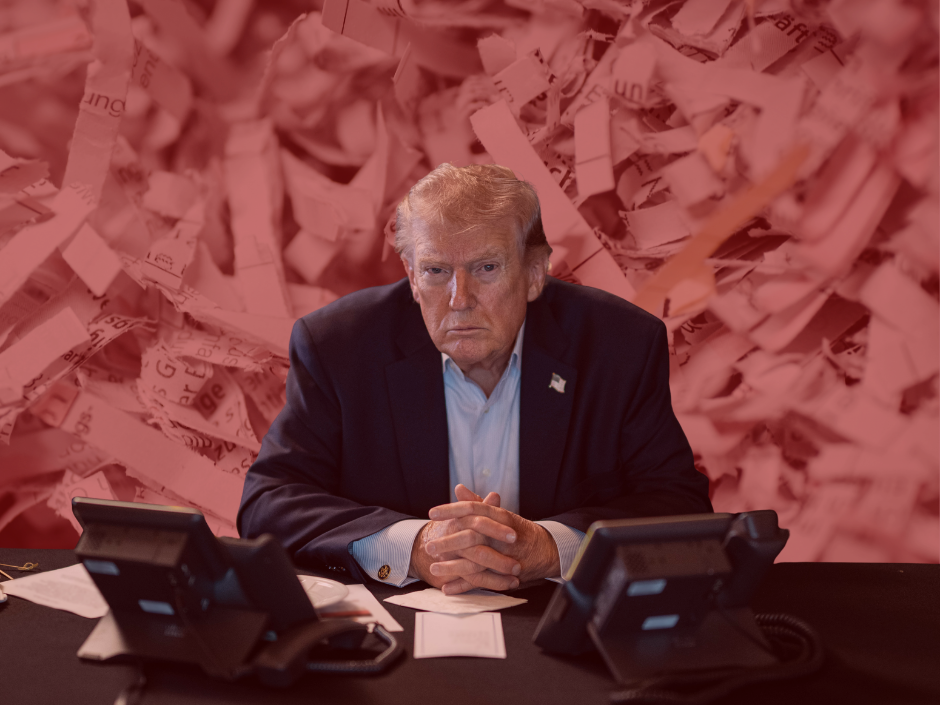
This week, we asked for urgent court action to prevent the Trump administration from losing or destroying important presidential records, along with the American Historical Association.
We filed our motion for a preliminary injunction just days after we sued to challenge a recent opinion by the Department of Justice’s Office of Legal Counsel that declared the Presidential Records Act is unconstitutional and said that President Donald Trump “need not further comply” with its requirements. That opinion breaks from decades of settled law and Supreme Court precedent, and it puts the public’s access to hundreds of millions of records at risk — including more than 700 million White House emails — which could provide additional details on corruption, conflicts of interest, and abuses of power during Trump’s first term.
Former National Archives and Records Administration General Counsel Gary Stern wrote in an op-ed this week, “[t]he office is wrong to conclude that Congress has no authority to pass a law to preserve the nation’s most important records — those of each presidency — and the American Historical Association and American Oversight are right to jump to the act’s defense.”
We asked the administration to commit to preserving records during the case, but they refused. That means that records documenting government actions are at risk of being deleted, destroyed, or never captured in the first place. Losing presidential records from the Trump administration could undermine the ability of historians, journalists, Congress, and the public to understand and evaluate government decision-making.
We filed suit because without this urgent court intervention, important records documenting presidential decision-making could be lost to history. “Once that happens, the damage cannot be undone, they are gone for good,” warns our Deputy Executive Director Liz Hempowicz.
We’re fighting to hold state elections officials accountable
Three members of the Georgia State Election Board (SEB) recently filed an amicus brief supporting the Trump administration’s continued efforts to undermine election results — and there was a reasonable inference that they may have gathered in secret to do it, despite what the law says. They owe the public, who they are supposed to serve, some answers.
This week, we sent those SEB members — Janice Johnston, Janelle King, and Salleigh Grubbs — a letter demanding more information about their actions. We sent the letter to ask them to address why they appeared to have gathered outside of a properly-noticed meeting about the brief, and why the filing appeared to have presented the trio’s opinions as if they reflect those of the full board, even though the board did not vote or deliberate.
In the letter, we raised concerns that there was a reasonable inference that the members may have violated state law and overstepped the board’s authority, conduct our Deputy Executive Director Liz Hempowicz said “cuts directly against Georgia’s open meetings law and the public’s right to know how State Election Board decisions are made.”
This isn’t the first time we’ve taken the SEB to task for an apparent violation of the state’s Open Meetings Act. In July 2024, we sued the SEB after three members (including Johnston and King) illegally met to consider controversial proposals. That lawsuit remains active following our October 2025 victory in the Georgia Court of Appeals. We also announced a settlement in November 2025 in a different lawsuit against the SEB and board member Johnston, resolving claims that Johnston had significantly delayed responses to our public records requests in the run-up to the 2024 election.
On the records
Emails show Maricopa County official appears to have coordinated with Trump DOJ
Maricopa County, Ariz., was central to conspiracy theories about the 2020 election. Recently, the DOJ subpoenaed records to investigate the county’s 2020 election — again. We uncovered emails that show that a top county official was in contact with the DOJ as it planned that investigation and demanded information about voters.
The emails suggest that Maricopa County Recorder Justin Heap met with Arizona’s top federal prosecutor right before the DOJ told Maricopa County it would investigate, which raises questions about his coordination with federal officials.
Election officials shouldn’t “blur the line between election administration and politicized law enforcement,” our Deputy Executive Director Liz Hempowicz said. “This pattern risks turning baseless suspicion into policy and sweeping eligible voters into investigations they should never be part of.”
American Oversight in the news
- Historians suing Trump administration say National Archives won’t commit to preserving presidential records during lawsuit (CNN)
- Exclusive: Maricopa County Recorder Justin Heap discussed election records, litigation with feds (Votebeat)
- Watchdog: Election board members may have broken law with legal filing (Atlanta Journal-Constitution)
- The Justice Department’s position on presidential papers is astounding (Washington Post)
- New disclosures reveal how DOGE actually worked (Washington Post)
Other stories we’re following
- John Eastman disbarred in California over efforts to overturn 2020 election (The Hill)
- President threatens to fire fed chief if he does not resign (New York Times)
- Iran war has some US water utilities facing a fluoride shortage (Associated Press)
- Trump’s Memphis Crime Task Force arrested over 800 immigrants, records show. Only 2% of the arrests were for violent crimes. (ProPublica)