
Taking the Fight for Trump’s Records to Court
In this week’s hearing, we made the case for an emergency order to preserve presidential records.
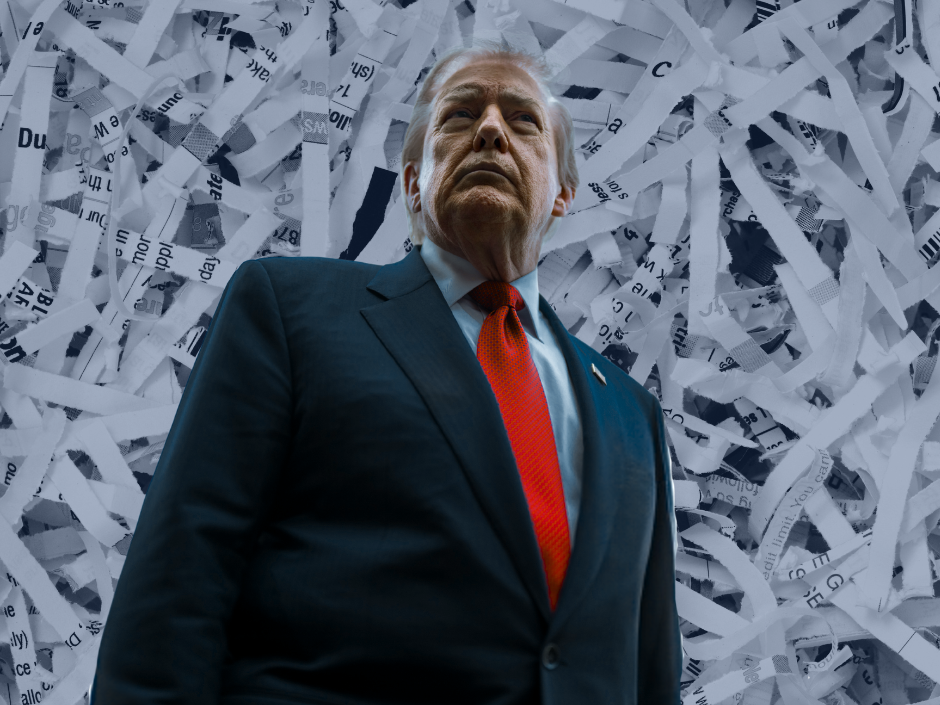
We were in court this week, seeking an emergency ruling to prevent President Donald Trump’s documents from being permanently lost or destroyed.
Last month, the Department of Justice’s Office of Legal Counsel (OLC) issued a sweeping opinion that the Presidential Records Act (PRA) is unconstitutional and that Trump “need not further comply” with its requirements. If OLC’s opinion is allowed to stand, it could block public access to hundreds of millions of records — including more than 700 million White House emails — that could provide additional details on the administration’s corruption, conflicts of interest, and abuses of power.
We quickly filed suit to defend the PRA, along with the American Historical Association. We also filed a motion for a preliminary injunction to block the Trump administration from losing or destroying records. That is essential, because the Trump administration has refused to commit to preserving all presidential records during the course of the litigation — meaning key records documenting government actions are at immediate risk.
“This case is about far more than record-keeping. It’s about whether the president can unilaterally place his actions beyond public scrutiny,” our Executive Director Chioma Chukwu said. “If records documenting the president’s most consequential decisions, internal deliberations, or abuses of power can be hidden, deleted, or never preserved in the first place, the public loses one of our democracy’s most important safeguards.”
It’s hard to know how DOGE operates. That’s by design.
The Department of Government Efficiency (DOGE) isn’t dead. It reportedly has 90 employees across different federal agencies — and it’s still growing. But DOGE has taken steps to shield the names of its operatives and records of its actions.
When we asked various federal agencies for records identifying their DOGE team members, for example, the responses sparked questions: The CDC, FDA, and Department of the Interior directly denied having DOGE teams, even though public reporting indicates this is misleading at best. We obtained a directory of DOGE operatives at DOD, but all the faces and names are redacted.
We’re using the Freedom of Information Act (FOIA) to fight for answers, including about how DOGE is being embedded across federal agencies, and how its staff are influencing government policies.
We have had some significant wins. Through our FOIA requests, we’ve uncovered the names of people working for DOGE in several agencies. DOGE also created a records retention policy after we went to court to get them to preserve documents.
We are still fighting for more information, though. We have ongoing lawsuits demanding that DOGE and federal agencies publicly release records about their work.
Read more about what we’ve learned about DOGE — and why we still don’t know more.
American Oversight in the news
- Will Donald Trump be allowed to destroy his records? (The New Yorker)
- A new low? Presidential records and the role of OLC (Lawfare)
- Donald Trump is trying to change the rules about keeping records (NPR)
Other stories we’re following
- 10,000 rulings: The courts’ overwhelming rebuke of Trump’s ICE policies (Politico)
- A noncitizen says she was told she could vote. Then Customs detained her at the airport and threatened to deport her. (ProPublica)
- Iran war pushed inflation to highest rate in nearly three years (Washington Post)
- FEMA’s acting administrator is out, for the third time under Trump (Politico)