

American Oversight v. DHS, CBP, ICE, USCIS, and DOL — Immigration Enforcement Policy Directives and Communications
Jun 20, 2025
Internal training documents and emails show how federal immigration officers are using force and being trained on individuals’ privacy rights, and what we still need to learn.
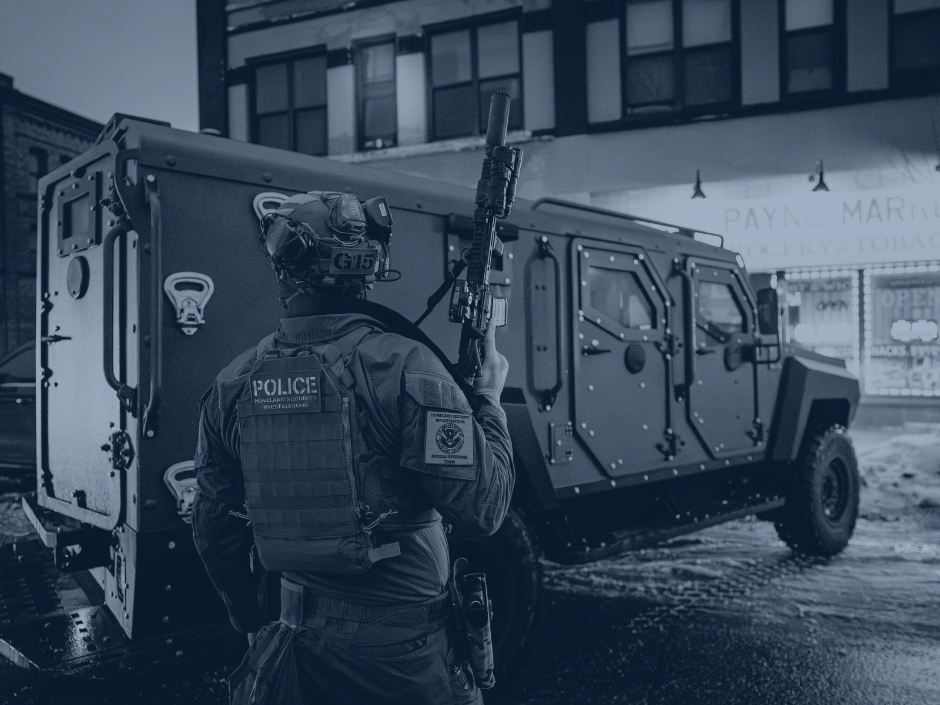
ICE has expanded rapidly in the past year, in staffing numbers and in reach. Officials say they have hired more than 12,000 agents in less than a year, which President Trump has deployed to at least 15 American cities. The violence ICE officers bring into these communities has been well documented: Officers have assaulted, detained, and killed protesters and suspected undocumented immigrants. The public has a right to know more about how these federal law enforcement officers may impact their or their neighbors’ lives, including how officers are being trained and whether there are consequences for violating that training.
We filed Freedom of Information Act (FOIA) requests with the Department of Homeland Security (DHS) in early 2025 for information about the administration’s planned immigration enforcement actions and tactics to increase arrests and deportations. We also requested records from Immigration and Customs Enforcement (ICE), Customs and Border Patrol (CBP), and U.S. Citizenship and Immigration Services. The agencies failed to release the records as required by law, so we sued for their release in June.
Through our lawsuit, we obtained training materials that show ICE agents were instructed on individuals’ constitutional protections against arbitrary government searches and seizures in early 2025. Emails also show a dramatic increase in the number of use of force incidents reported to ICE during the first two months of the Trump administration. This suggests there could be major gaps between how ICE agents are being trained and how they are operating on the streets of U.S. cities. It also underscores the need for more answers about the administration’s expanded immigration enforcement actions.
Here’s what we learned from ICE’s internal documents.
Training materials dated July 2025 advised ICE officers on their obligations under the Fourth Amendment, which protects citizens and noncitizens from being stopped or detained by law enforcement without cause and/or a warrant. Officers were advised that they must obtain a warrant before searching an individual or making an arrest, and that they are required to identify themselves as immigration enforcement “as soon as it is practicable and safe to do so” when making an arrest. The officers were told their badges should be “clearly displayed when making a stop for officer safety/liability,” but were advised they are not required to publicly identify themselves before making an arrest.
The training advised ICE agents that they could use “necessary and reasonable” force against “disruptive protesters” to make an arrest, but that they must first attempt to defuse the situation and tell the protester they could be violating federal laws. Any protesters arrested by ICE officers must be advised of their rights before being interrogated and “be brought before a judge without unnecessary delay,” according to the training. It also tells agents that the local U.S. attorney’s office “must be willing to accept” the prosecutions of any protesters that ICE officers arrest, and that they are only allowed to enforce federal laws, not state laws. The training includes scenarios of “disruptive protesters” — including a hypothetical instance in which a group of protesters surround a car to protect an individual inside from arrest — and discusses the officers’ “legal options … to address the group’s conduct.”
The training materials also discuss I-205 administrative warrants, which are issued by a federal agency official, not a judge, and have been used by ICE officers to arrest individuals targeted for immigration enforcement. Officers were told that administrative warrants do not permit them to enter private areas like homes and businesses. Training notes advised instructors that they could tell officers the use of I-205 warrants for immigration enforcement is under review, if asked.
The documents show that in the first two months of Trump’s second administration, DHS was aware of a 353 percent increase in use of force incidents involving officers.
The documents include 10 reports of DHS officers’ use of force against citizens and noncitizens that occurred in early 2025, as well as descriptions of two large-scale ICE operations that took place in California and Massachusetts in March. The reports contain instances of agents shattering car windows, deploying chemical agents, and using extreme physical force to detain individuals.
One report details an ICE officer’s fatal shooting of a U.S. citizen in March 2025, in South Padre Island, Texas. The victim’s name was redacted in the report, but a lawyer for his family confirmed it was Ruben Ray Martinez, a 23-year-old from San Antonio. Identifying details about the officer who killed Martinez were also redacted.
In the report, ICE stated that an officer was conducting traffic stops and asked a driver, now known to be Martinez, to exit his vehicle. The report claims the driver “accelerated forward and hit an ICE agent,” and that “another ICE agent responded by firing multiple rounds into the car.”
The version of events in the documents conflicts with descriptions from a witness who was in the car, Joshua Orta. In a written statement, Orta said that the two men were trying to comply with commands to turn the car around, and offered no resistance when an agent approached their car and “slapped the hood.” Orta says an officer “seemed to be trying to get in front of the car,” at which point the scene became chaotic. According to Orta, agents then yelled at Martinez to stop, drew their guns, and fired through his open window. Orta died in an unrelated car crash in February 2026.
Ruben Ray Martinez’s mother, Rachel Reyes, said in an interview that Orta’s description of events matched what investigators had initially told her.
There are striking similarities between Martinez’s death and the death of Renee Good, who was also killed by ICE agents while she was in her vehicle. In both cases, there are serious discrepancies between eyewitness accounts and the official report, raising serious concerns about how federal use-of-force incidents are documented and disclosed.
ICE and the Texas Department of Public Safety withheld information about federal agents’ involvement in Martinez’s killing for nearly a year — and only released details of the shooting after we fought in court to force the Trump administration to turn over records of ICE’s misconduct.
In February, we sent additional FOIA requests to the Texas Department of Public Safety and the South Padre Island Police Department for records related to Martinez’s killing.
Despite the increase in reports of violence by ICE officers, ICE officials appeared to focus on prosecuting the smaller number of assaults on federal law enforcement officers. Emails show 67 incidents of ICE officers’ use of force were reported between Jan. 19 and March 20, 2025. During that same period, 28 assaults on ICE agents were reported.
In response to those numbers, the head of ICE’s Office of Firearms and Tactical Program Use of Force Analysis Unit noted the “huge increase” in assaults on ICE officers, and suggested ways to increase prosecutions in these instances. Officials did not make any similar comments on addressing the use of force by ICE officers, though there were more than twice as many of such incidents reported.
DHS published a plan to deploy body-worn cameras to ICE agents nationwide in March 2025, but it has not been made publicly available. Lawmakers have called for ICE officers to wear the cameras to increase accountability for their actions in the wake of agents’ killings of Renée Good and Alex Pretti.
The plan includes information on how ICE could equip agents across the country with the body-worn cameras and train them to use the cameras and save videos in compliance with individuals’ privacy rights. The plan was developed by ICE’s Office of Firearms and Tactical Programs, Office of the Principal Legal Advisor, and Office of Regulatory Affairs and Policy, in coordination with DHS’ Office for Civil Rights and Civil Liberties.
ICE’s published body-worn camera plan, dated February 2025, tells officers to activate their cameras “as soon as practicable at the beginning of an Enforcement Activity” and to deactivate them “when the activity is concluded.”
The unpublished plan says that ICE officers’ “safety, the safety of members of the public, and the safe operation of government vehicles — not the ability to record — will always be the primary consideration when using a BWC.” The policy “prohibits [officers] from placing themselves or others in dangerous situations solely to record an incident.”
Clarity on immigration enforcement officers’ use of body-worn cameras — and DHS’s retention of data from the devices — is especially important now, amid the increased enforcement actions and use of force by officers. In February 2026, DHS released body-worn camera footage from a CBP officer-involved shooting that took place the prior October, calling into question the Trump administration’s account of the incident and further highlighting the importance of the devices for accountability.
The public has not been made aware of plans to distribute the cameras to officers or to require their use.