

Reports & Features
December 13, 2023
The Campaign to Dismantle ERIC
2020 electionelection administrationelection denialvoting rights
How the Election Integrity Network is using its influence to make it harder to vote and easier to undermine election results.
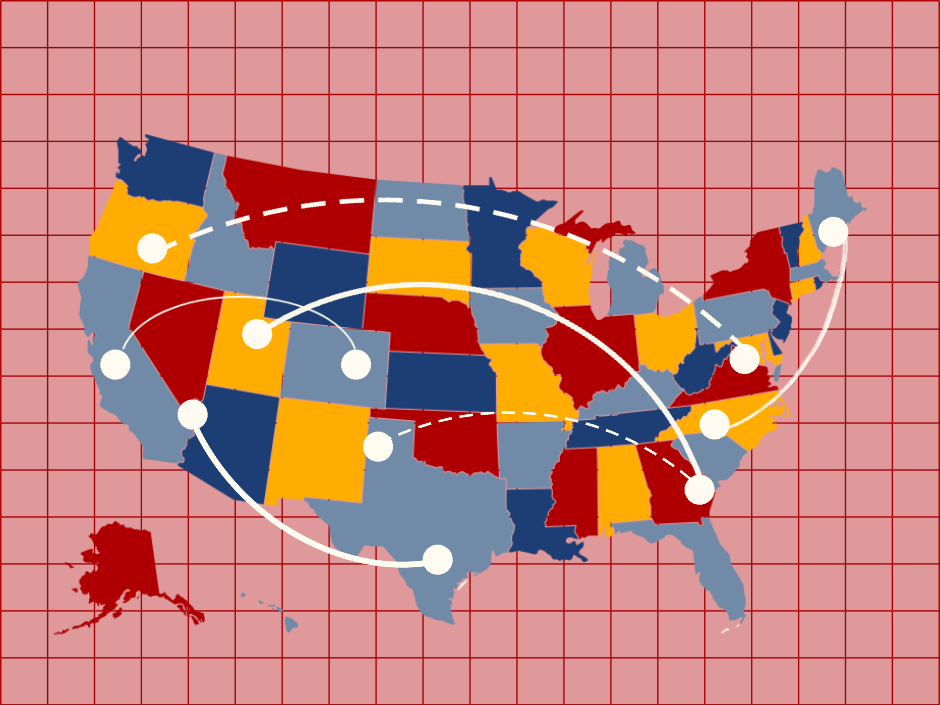
The Election Integrity Network (EIN) is a coalition of state-level advocacy groups that push for changes to the way the U.S. conducts elections, based on conspiracy theories about voter fraud. Though it may not be a household name, it’s highly influential: According to a 2024 New York Times article, EIN has “done more than any other group to take Mr. Trump’s falsehoods about corruption in the democratic system and turn them into action.” EIN’s tactics include changing state election laws, mobilizing mass voter registration challenges, and placing its members in positions of power at the local, state, and federal level.
American Oversight is investigating through dozens of Freedom of Information Act requests and litigation to investigate EIN’s activities. Our work has revealed details about EIN’s nationwide coordination and influence.
Right-wing activists have been working to make it harder for certain groups to vote for decades, but their efforts intensified following the 2020 election. President Donald Trump and his allies have relentlessly claimed that there was widespread fraud throughout the 2020 election, and have spent years trying to refute the results and propose new policies that will guarantee their wins in the future.
The Election Integrity Network plays a key role in organizing election denial activists. It was founded in 2021 by Cleta Mitchell, an attorney who helped coordinate Trump’s attempt to stay in power after he lost the 2020 election. Since then, Mitchell has been the “connective tissue” to a lot of the continued effort to undermine voting rights and sow doubt in the results of elections, our Executive Director Chioma Chukwu told Salon in 2026.
EIN is closely tied to prominent conservative groups and funders. It was originally “incubated” by the Conservative Partnership Institute, an organization connected to Trump’s former chief of staff Mark Meadows. Early on, EIN received money from powerful conservatives such as Richard Uihlein and Rebecca Dunn, and groups including Citizens for Renewing America, which was founded by Project 2025 architect and current Office of Management and Budget Director Russel Vought.
Since its founding, EIN has grown to include affiliate groups in at least 39 states. EIN affiliate groups have been a key part of removing tens of thousands of people from voter rolls in Ohio, worked with legislators to craft voter suppression legislation in North Carolina, and coordinated with the Georgia State Elections Board to push a measure that would make it easier to discredit election results.
Mitchell’s organizations are well-funded and are distributing money to EIN affiliates across the country. For example, the FAIR Elections Fund, another group run by Mitchell, gave $545,000 to a foundation that runs EIN’s Arizona chapter in the 2024 to 2025 fiscal year. Arizona is a key swing state and this was the fund’s largest contribution to any state-based group and more than seven times as much as the group received the prior year. The Conservative Partnership Institute, the group that incubated EIN and is still connected to it, raised $34 million in 2024.
The Election Integrity Network has been connected to efforts to upend how states maintain accurate voter rolls. Until 2022, states relied on the Electronic Registration Information Center, which was a non-controversial nonprofit that quietly helped states clean up their voter rolls by securely comparing voter data. Then, a January 2022 article on a fringe right-wing website set off a cascade of misinformation that eventually led nine states to withdraw and adopt flawed alternatives pushed by right-wing groups.
The Election Integrity Network has supported EagleAI, a database used by right-wing activists on the hunt for voter fraud, as an ERIC alternative. Voting-rights experts warn that EagleAI “draws inaccurate conclusions” and cannot be trusted to provide reliable information, and records we obtained of EIN meetings showed EagleAI’s founder, Dr. John “Rick” Richards, acknowledging the deficiencies of the software. Records we obtained in 2026 show Richards has met with officials in multiple states to promote ELLY and Psephos, two similar error-prone tools.
In addition to voter roll maintenance, EagleAI can also be used to autofill voter registration challenge forms. Cleta Mitchell has helped roll out this EagleAI software to activists within EIN to aid in their mass voter challenges — complaints lodged with an election body that assert a voter is improperly registered to vote.
In May 2026, the Election Integrity Network published a “Model Election Laws Handbook” that offered a roadmap for making it harder for people to vote and to make it easier to challenge election results. It was proposed as a legislative guide for states.
Specifically, the handbook proposed capping early voting to just seven days prior to Election Day, limiting absentee voting to just those who have a documented qualifying excuse, prohibiting ballot drop boxes, and rejecting mail-in ballots that were post-marked prior to the deadline but arrived after Election Day. It also recommended requiring voters present identification that shows both their citizenship status and state of residence — something that most IDs do not display since passports do not include what state you live in and most driver’s licenses don’t specify citizenship status.
These proposals would make it harder for people to vote. Shortening early voting periods give people fewer options and longer lines. Around 21.3 million people do not have easy access to documents that prove their citizenship. People of color, young adults, seniors, people with disabilities, and people with lower incomes are less likely to have current driver’s licenses than other Americans.
The handbook also included ways to make it easier to stall or stop the election certification process and to make it easier to challenge voters’ registration. The release of this handbook showed that EIN was escalating its campaign to sow doubt and distrust in American elections because the proposals would make it significantly more difficult for most Americans to vote and make it easier to interfere in the results of our elections.
Since Trump has been back in office, the Election Integrity Network has used its close ties to the administration to push its anti-voting agenda. People who have been members of EIN or its affiliates have been hired at the Departments of Justice and Homeland Security.
For example, Heather Honey is an election-denier activist who founded Pennsylvania Fair Elections, the Pennsylvania affiliate of EIN. Honey was made the deputy assistant secretary for elections integrity at the Department of Homeland Security (DHS) during Trump’s second administration. In July 2026, she was promoted to senior counselor with the DHS Office of the Secretary.
Honey’s appointment and remarks have alarmed election officials, who were reportedly “confused and anxious” after she echoed rhetoric long associated with baseless claims of widespread voter fraud during an official DHS meeting. Honey is reportedly working on limiting mail-in voting ahead of the midterms.
Members of the Trump administration have attended EIN meetings and offered details about the administration’s behind-the-scenes efforts to implement EIN’s agenda. In June 2025, David Jennings, DHS’s associate chief of U.S. Citizenship and Immigration Services, attended an Election Integrity Network virtual call and discussed DHS’s work on creating a national citizenship database.
Voter list maintenance should be routine updates to lists of registered voters who have moved, died, or otherwise become ineligible to vote in their previous jurisdiction. Instead, EIN has called for more frequent and extensive purges of the lists.
This weaponization of voter roll maintenance has already resulted in the wrongful removals of eligible voters. Election experts have also warned that sensationalizing the routine process of voter roll maintenance as part of preventing alleged illegal voting could further create the false impression that elections are undermined by widespread voter fraud.
Already, an EIN affiliate played a key role in getting an Ohio county with a recent surge of Black and Asian residents to purge 20,000 people from its voter rolls. This is especially concerning because EIN is pushing voter flawed voter roll maintenance tools like EagleAI that produce unreliable information and make it easier for everyday people to make baseless voter registrations challenges.
EIN’s proposals in its “Model Elections Handbook” include the alarming suggestions to make it easier to not certify election results, the process by which local and state election officials certify the accuracy of an election and finalize the results. Since 2020, a growing number of officials have refused to certify results, citing vague and unfounded concerns about voting equipment, errors that did not impact the election results, and election laws they consider unfair.
As experts have pointed out, permitting certification delays raises the risk that partisan officials will cast doubt on or to subvert elections that don’t go the way they or those influencing them want. Even if courts eventually force officials to certify, the damage is still done: Delays give more fuel to conspiracy theories and further damage voter confidence.
By continuing to promote falsehoods about widespread voter fraud, EIN perpetuates the lie that non-citizens are casting ballots to skew election results, which can lead to race-based and anti-immigrant harassment, intimidation, and discrimination.
This misinformation also sets the stage for Americans to reject future election results, and can undermine faith in the democratic process for people who believe the false theories that ineligible voters are participating in our elections. And it makes election officials’ jobs more difficult and less safe: Election workers have reported experiencing violent threats and harassment at their jobs, including by supporters of disproven election fraud theories.
The anti-voting measures that EIN is pushing disproportionately harm voters of color, Native Americans, immigrants, seniors, young people, people with disabilities, and people with lower incomes. Many of these groups are already historically marginalized and when new barriers to voting are enacted, they lose even more of their political power, and the needs and opinions of people with fewer barriers to voting are given more weight. The consequences of losing political power are stark. For example, recent legislation cut taxes for the rich while making it harder for low-income families to receive food assistance. This can stoke widespread distrust in the election system by these marginalized groups, who are also more likely to be harassed or intimidated when trying to participate.
In March 2026, we published government records showing that state election officials have met with EagleAI founder Dr. John “Rick” Richards, Jr. to discuss newer tools known as ELLY and Psephos. The documents showed that outreach around these tools has occurred across multiple states, including Missouri, Texas, and Rhode Island, as part of an apparent broader effort to introduce the software to election officials nationwide. In Missouri, records show that election officials met with Richards’ representatives, viewed a presentation, and engaged in follow-up communications regarding potential use of the tools.
Additional records we obtained from North Carolina showed election officials agreed to view a demonstration of ELLY after it was promoted by individuals affiliated with election denial activists and networks, including a group whose members have been trained to use third-party voter challenge software.
Our previous investigations have also helped shed light on Heather Honey’s extensive involvement in the election-denial movement and her outreach to state officials advancing baseless claims about voter fraud. She shared what appears to be draft legislation with state legislators questioning the security of voting machines, contacted officials in multiple states urging withdrawal from ERIC and coordinated activities with Cleta Mitchell. We also obtained a February 2023 email from Honey to the Missouri Secretary of State’s office urging the state to “Return Control and Management of State Data Back to the States,” as well as her participation in communications following an anti-ERIC summit.
In Arizona, Maricopa County County Recorder Justin Heap has raised alarm bells after he took aggressive action based on largely inaccurate information. In May, Heap referred more than 200 people to the Arizona Attorney General’s Office for potential prosecution. The individuals were registered to vote but had been flagged as noncitizens by a federal database. In actuality, just eight of these people had illegally voted. Records we obtained through public records requests show that Heap has coordinated with a leader of EIN’s Arizona chapter, EZAZ.
In October 2025, we sued for records related to Heather Honey’s Honey’s hiring at DHS, communications, and calendars as well as any communications involving EIN.
We have also filed dozens of public records requests at the state and federal level to investigate EIN’s activities and influence.
We want to know if DOJ is coordinating with EagleAI or considering using the software. We requested communications among individuals associated with EagleAI and officials at the Department of Justice, as well as communications containing key terms related to EagleAI.
Trump administration official David Jennings reportedly shared information about the SAVE database in a June 2025 EIN meeting. We want to know what, if any, data the Department of Homeland Security is sharing with EIN so we requested any documents or materials shared with the group as well as communications between David Jennings and Cleta Mitchell.
We’re also investigating the threat of federal agencies seizing ballots and voting machines in the aftermath of the 2026 midterms. We asked DHS, DOJ, the FBI, and several more agencies for related records, including their communications with Cleta Mitchell and EIN.
Marshall Yates was previously the executive director of EIN and is now the FBI’s assistant director of the Office of Congressional Affairs. We requested Yates’ communications with the White House and Congress as well as his calendars and ethics waivers.
We want to know how EIN is influencing state lawmakers and election boards. We’ve sent requests for EIN and its leaders’ communications and other records with the Ohio legislature, Georgia State Election Board, North Carolina State Board of Elections Chief of Staff Brian LiVecchi, and Michigan county canvassers.
We’re also investigating if Cleta Mitchell or EIN have been involved in states’ redistricting after the Supreme Court’s 2026 Callais decision that permits states to redraw congressional maps to reduce representation for people of color. We’ve asked for communications between Mitchell and EIN with legislators in Georgia, Louisiana, North Carolina, Texas, and Florida.
Finally, we’re investigating EIN’s potential ties to the American Legislative Exchange Council, a powerful conservative group that writes model legislation on everything from voting restrictions to limiting campus protests. Photos shared on EIN’s website indicate that Cleta Mitchell and other EIN staff have attended and presented at ALEC events. We’ve requested materials and communications related to ALEC programming to better understand how EIN participated in ALEC’s summer meeting.