
ICE’s Expansion Under Trump
What we know, and what key information we’re still missing.
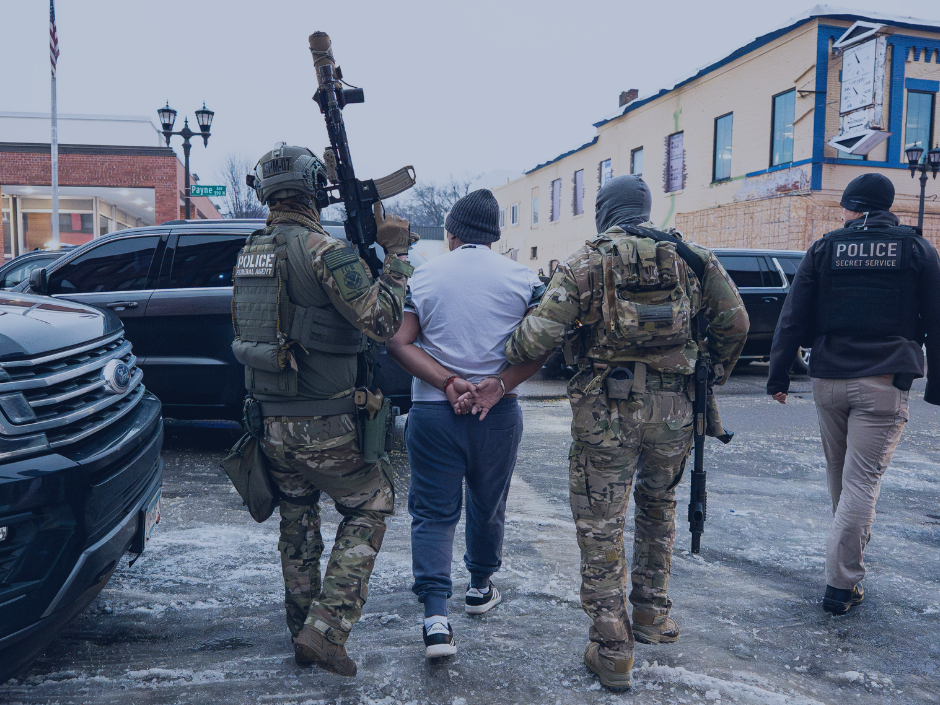
Immigration and Customs Enforcement (ICE) agents have swarmed American cities and communities, attempting to meet the Trump administration’s quota of 3,000 immigration arrests a day. Empowered by a massive budget increase in summer 2025, the agency has been expanding rapidly: hiring agents, leasing facilities, forming partnerships with local police departments, and gaining access to a number of government data sources. ICE’s growing authority, ranks, and budget have been accompanied by increasingly aggressive tactics that claimed at least 33 lives in 2025.
What is ICE Doing?
ICE is going after broader swaths of immigrants to meet daily arrest quotas
In May 2025, then-Department of Homeland Security (DHS) Secretary Kristi Noem and White House Deputy Chief of Staff Stephen Miller reportedly demanded that immigration enforcement arrest 3,000 immigrants a day — roughly triple the number of daily arrests made in January 2025.
To try to meet this quota, the Trump administration reassigned agents who were investigating immigrants with serious criminal backgrounds to instead arrest immigrants without criminal records, including at immigration appointments and court hearings, to grow arrest numbers. In January 2025, there were only 858 people with no previous criminal charges in ICE custody. As of February 2026, there were 24,495. In the first year of Trump’s second term, less than 14% of people arrested by ICE had violent criminal histories.
ICE is targeting immigrants at sensitive locations like hospitals and schools
Just two days into Donald Trump’s second administration, DHS announced it was removing protections for undocumented immigrants at sensitive locations like places of worship, hospitals, schools, and courtrooms. Subsequently, ICE has regularly arrested immigrants at these places, including raiding workplaces, targeting churches and synagogues around Thanksgiving and the winter holidays, reportedly showing up at schools to talk to children with immigrant parents, and arresting people at their immigration hearings at courthouses.
ICE is using its massive budget to double its ranks
The July 2025 budget reconciliation package, officially called the One Big Beautiful Bill Act, ballooned ICE’s cash, giving the agency a base budget of $10 billion a year plus $75 billion to spend over the next four years. ICE is spending $45 billion of this money to ramp up its mass detention facilities.
Another $30 billion of this money went to ICE’s initiative to hire 10,000 more officers by the end of 2025. Alarming recruitment ads included messages and imagery that echoed white nationalists and disparaged immigrants. As part of this recruitment push, ICE offered $50,000 sign-on bonuses and $60,000 in student loan forgiveness for police officers who moved to the agency.
This offer seems to have been effective. Because so many correctional officers have moved to ICE, there is now a staffing shortage in federal prisons. In January 2026, DHS claimed that it had met its goal, signing 12,000 new recruits in the second half of 2025 — more than doubling its force.
As of June 2026, ICE’s effort still isn’t over. The agency is spending $100 million on a 1-year massive recruitment campaign that uses location-specific advertising and online influencers to target military enthusiasts and gun rights supporters.
ICE is lowering standards for new recruits and giving them way less training
In August 2025, as ICE ramped up its recruiting push, it removed age requirements and lowered fitness standards. The agency also removed more than 40 percent of instruction from its basic training program — roughly 240 hours. Further, ICE cut half of the time spent on firearms training, reduced Spanish language classes, eliminated assessments of recruits’ knowledge of skills specific to immigration enforcement, and slashed dozens of hours of classroom time devoted to case processing and agents’ legal authority.
ICE is using more force more often
Records we obtained through the Freedom of Information Act show that in the first two months of Trump’s second administration, DHS was aware of a 353 percent increase in officers’ use-of-force. Reports we obtained contain instances of agents shattering car windows, deploying chemical agents, and using extreme physical force to detain individuals.
We have seen this in communities across the country: In Minneapolis, two American citizens, Renee Good and Alex Pretti, were killed by immigration agents. Ruben Ray Martinez was shot to death by a federal agent in South Padre Island, Texas. In Chicago, ICE deployed tear gas near a public school, zip-tied children’s hands as part of a 1 a.m. raid, and fired rubber bullets. In Portland, Ore., federal agents fired pepper balls and tear gas at a family-friendly protest. ProPublica identified at least 79 children across the country who have been harmed by tear gas or pepper spray deployed by federal agents.
ICE is conducting mass surveillance
ICE is using surveillance tools to watch, arrest, and scare immigrants and ICE’s critics, many of whom are simply exercising their First Amendment rights. Many of these resources were purchased with the agency’s recent budget windfall. ICE purchased access to Penlink and Webloc, two surveillance apps that track people’s movements through their cell phones — all without a warrant. The agency is using facial recognition app Mobile Fortify, a database of Department of Motor Vehicle data, and a $5 million subscription to Thomson Reuters for license-plate-reader data for surveillance.
ICE has also sought and received individuals’ sensitive data from several government agencies. Thanks to an agreement with the Department of Health and Human Services (HHS), ICE has the dates of birth, names, and home addresses of undocumented immigrants who are in the Medicaid database. ICE has access to flight data from the Transportation Security Administration (TSA), and is also reportedly receiving voter registration data seized by the Department of Justice (DOJ). The IRS gave ICE information on about 47,000 people. In March, a federal judge determined that the IRS had broken federal tax law by disclosing these addresses to ICE. Nonetheless, tech company Palantir is reportedly developing an app for ICE, called ELITE, that uses AI to aggregate addresses and other sensitive data, to make immigration crackdowns easier.
ICE is partnering with local police and the military
ICE’s operations have been aided by local police through the 287(g) program that deputizes officers from state and local law enforcement agencies to act as immigration enforcement agents. These 287(g) agreements have exploded during the second Trump administration: In December 2024, ICE had entered just 135 287(g) contracts; ICE has at least 1,888 contracts across 40 states and territories as of June 2026. Read more about how we’re using public records to investigate this program’s expansion here.
ICE is also partnering with the military. For example, in July 2025, the Trump administration announced it would send 200 Marines to support immigration enforcement in Florida. The next month, the National Guard soldiers went to 9 cities in Florida to help ICE with tasks at detention facilities. As of August 2025, 20 states had reportedly authorized the National Guard to assist ICE. Troops were also sent to aid immigration crackdowns in Los Angeles and Chicago — against city and state leaders’ wills.
ICE is detaining people in places not intended for civilians
In February 2025, ICE owned only 10 of the 220 facilities it used to jail people. But thanks to the huge influx of funding for ICE, the agency is attempting to implement a mass detention system by renting and purchasing warehouses to convert into detention centers as part of the “ICE Detention Reengineering Initiative.” As of February 2026, ICE had purchased nine of the 24 warehouse facilities it plans to convert. Protests and local outrage at proposed warehouse sites have blocked ICE from purchasing 12 warehouses.
Prior to the warehouse plan, the Trump administration pursued other extreme measures to detain more people. Just nine days after returning to the White House, Trump signed an executive order calling for 30,000 people to be held at the Guantánamo Bay military prison to provide additional capacity for ICE. Guantánamo Bay is remote, providing limited access to attorneys or family members, and detainees are supervised by members of the military who have been trained to guard people accused of war crimes rather than civil crimes.
In February 2025, Trump announced plans to expand the detention of immigrants to other military bases, building a nationwide network of facilities that includes a “deportation hub” in Fort Bliss, Texas, intended to hold up to 10,000 people. The growing role of the Department of Defense in immigration enforcement raises concerns about potential rights abuses, as officials may not be properly trained and military facilities have a history of poor conditions.
Why This Matters
ICE’s crackdowns have created widespread fear in many communities. Many immigrants have reported that they are afraid to take their kids to school, go to work, and attend community events, for fear of being stopped on suspicion of being an immigrant. Citizens who attempt to document or protest ICE operations are also being arrested in high numbers.
The violence ICE officers bring into communities has been well documented: Officers have assaulted, detained, and killed protesters and suspected undocumented immigrants. As our Executive Director Chioma Chukwu said in February 2026, “Behind every statistic is a person, a family, and a community forced to live with the consequences of ICE’s aggressive and inhumane enforcement tactics.”
It’s also deeply alarming that ICE avoids transparency. The agency kept its role in the death of Ruben Ray Martinez secret for nearly a year, until American Oversight was able to uncover information about his death through FOIA requests.
ICE’s tactics threaten the data security and privacy of everyone living in the United States. The agency is taking sensitive personal data — without people’s consent or knowledge — and repurposing it for immigration crackdowns. People’s voter registration data, social security information, tax details, and traveler data should be kept private and secure, not fed into databases with lax security measures.
These policies impact individual wellbeing and the economy as a whole. Research indicates that ICE enforcement has created a chilling effect that caused many people to drop out of the workforce. Construction, agriculture, child care, and manufacturing have all been hard hit. And people who rely on those industries — either for employment or because they need the services — are struggling. There is no evidence that US-born workers are filling the empty jobs — instead, people are simply having to go without.
What We’re Doing About It
What We’ve Already Uncovered
Documents we obtained revealed more information about ICE’s use of force and training
Records we obtained revealed that ICE knew that reports of violence by ICE officers had more than tripled, and that an ICE agent killed Ruben Ray Martinez in March 2025. The internal incident report about Martinez’s death, first reported by Newsweek, garnered international news coverage and prompted widespread demands for accountability from local, state, and federal lawmakers.
The documents also showed that ICE officials appeared to focus on prosecuting assaults on federal law enforcement officers instead of reducing officers’ use-of-force incidents, even though there were far fewer assaults on officers than use of force incidents. Emails show 67 incidents of ICE officers’ use of force were reported between Jan. 19 and March 20, 2025. During that same period, 28 assaults on ICE agents were reported. In response to those numbers, the head of ICE’s Office of Firearms and Tactical Program Use of Force Analysis Unit noted the “huge increase” in assaults on ICE officers, and suggested ways to increase prosecutions in these instances. Officials did not make any similar comments on addressing the use of force by ICE officers.
We also obtained documents — ICE’s “Fourth Amendment Refresher Training (Revised July 2025)” and accompanying instructor notes — that show a discrepancy between legal guidance governing ICE conduct and what officers are told in training. The slide materials emphasize that a judicial arrest warrant is generally required to enter a home, and that easier-to-obtain administrative warrants “[do] not authorize entry into a residence.” Yet the instructor notes accompanying the training presentation state that if trainees specifically ask about the use of Form I-205 administrative warrants for home entry, instructors should advise that the issue is “under review.”
The juxtaposition of those materials mirrors former ICE attorney-turned-whistleblower Ryan Schwank’s Congressional testimony. Schwank said that ICE officials told him to train agents to believe that they had broad authority to enter homes without a warrant. Simultaneously, Schwank was told to not document that he was teaching agents this.
We also exposed the details of ICE’s data-sharing agreement with the IRS
ICE and the IRS had an agreement that allowed ICE to access sensitive taxpayer data. We made the details of the agreement public, revealing that ICE is seeking the addresses of people it is investigating — information that taxpayers entrust the IRS to keep confidential, and that the IRS is bound by law to keep safe. That includes undocumented immigrants, who pay income tax and have long relied on those promises from the IRS. This data-sharing arrangement was challenged in court, and a federal judge barred the IRS from continuing the practice.
What We’re Still Investigating
We’ve filed dozens of Freedom of Information Act requests to shed light on ICE’s tactics
Surveillance
We have requested records from the Department of Government Efficiency to learn if ICE is accessing DOGE’s databases of sensitive information on immigrants. We filed FOIAs for communications and briefings about ICE’s plan to expand its system of ankle monitors, GPS trackers, biometric check-in technology, and human agents that monitor people awaiting immigration court hearings or deportation. We filed FOIA requests to uncover how Palantir accesses and uses sensitive government data.
Targeting vulnerable communities and sensitive locations
After some public universities announced they planned to comply with new federal guidance allowing ICE to arrest people at schools, we requested communications and directives regarding this cooperation from key public universities in Texas, North Carolina, Arizona, and California. We also asked universities for their plans regarding data sharing with ICE and allowing ICE access to school property. In North Carolina, we sent public records requests to some school districts for communications and other records about potential efforts to track students’ citizenship statuses.
To investigate how ICE is targeting children, we sent FOIA requests to ICE for records regarding reported visits to schools to perform so-called welfare checks on immigrant children. After ICE failed to respond to these requests, we sued. We also asked for documents that could show how ICE is implementing Operation “Freaky Friday,” which offers unaccompanied children cash to self-deport. If the kids refuse, ICE reportedly threatens to arrest their family members.
To learn more about how ICE is targeting other previously protected sensitive locations, we asked ICE and other agencies for their internal guidance documents regarding raids at workplaces and related communications. We also requested documents from ICE that could show what top officials said and what orders they gave about a plan to target Spanish-speaking churches, mosques, and synagogues between Thanksgiving and Christmas in 2025. And to investigate reports that ICE is arresting people at courthouses immediately following their immigration hearings, we asked ICE, the Executive Office for Immigration Review (the agency within DOJ that oversees immigration hearings), and local law enforcement for communications, quotas, and agreements that could show if these courthouse arrests have been coordinated.
Partnerships With Local Enforcement and Other Federal Entities
The U.S. Postal Inspection Service, the law enforcement and investigation arm of the U.S. Postal Service, has reportedly been involved in making arrests or conducting immigration raids alongside ICE. We asked the USPIS for its communications, directives, trainings, and guidance regarding immigration enforcement responsibilities. We requested similar records from the DOJ because DHS gave agencies within DOJ, including the Drug Enforcement Agency and Bureau of Alcohol, Tobacco, Firearms and Explosives, immigration enforcement authority. We have also sent public records requests to police and sheriffs’ offices across the country to learn more about 287(g) agreements.
Recruiting and Media Strategy
To investigate ICE’s social media posts with stylized arrest videos and recruitment ads that invoke white nationalist themes, we asked ICE for communications and strategy documents regarding recruitment as well as ad budgets. The records could show who ICE’s target audiences are and why they are using this imagery. We also want to know more about ICE’s recruitment strategy, especially since ICE has lowered its minimum requirements. We asked ICE for communications, budgets, and strategy documents regarding recruitment tactics.
Operation Metro Surge in Minneapolis
After immigration agents murdered Renee Good and Alex Pretti, we requested top DHS, ICE, and Customs and Border Patrol officials’ communications sent in the days after the killings. We also asked for records reflecting any guidance or directives immigration agents in Minnesota were given following Pretti’s death.
We’re also going to court to fight for transparency around ICE operations
In June 2025, we sued ICE for records related to ICE’s targeting of immigrants at sensitive locations, use of force policy, search and seizure protocols, and trainings. That same month, we also sued ICE for documents related to the 287(g) agreements, including communications about the program, training materials, and internal guidance — information that could reveal how and why ICE slashed training requirements and expanded the use of these controversial agreements across the country.
We’re also suing ICE and multiple agencies for records about their data-sharing agreements. In January 2026, we sued ICE and the Transportation Security Administration for records that could help explain how the data-sharing program works, what data is being shared, whether safeguards exist, and how U.S. citizens have been impacted. We filed a similar lawsuit against ICE and the DOJ in March 2026, seeking documents that could shed light on how the DOJ is collecting voter data from states and how that information is being accessed or used by ICE.