
Voter ID Laws
How voter identification laws make it harder for everyday individuals — especially people of color, queer communities, and those with lower incomes — to participate in our democracy.
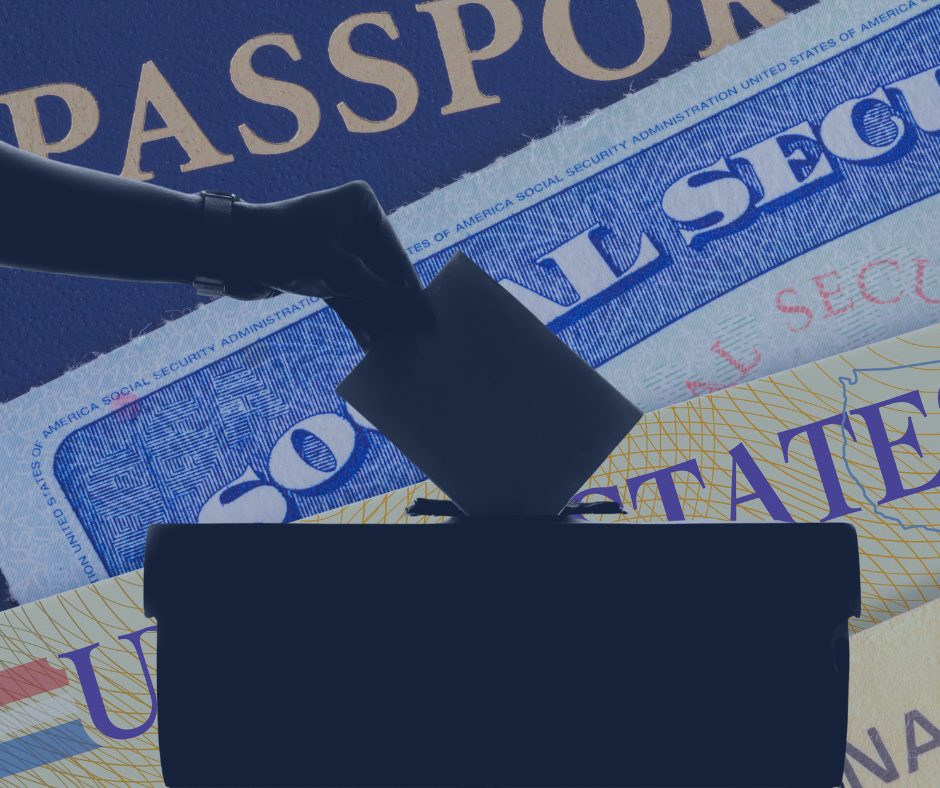
President Donald Trump and his allies have pushed for new and expanded voter ID measures in recent years, which would require voters to show government-issued identification to cast their ballots. These laws have been on the rise since 2010, and 36 states currently require some form of ID at the polls.
Politicians often pitch voter ID legislation by arguing that it is necessary to avoid voter fraud. However, election fraud is exceedingly rare. In reality, voter ID laws primarily prevent legitimate voters from participating in elections.
Most recently, President Trump has been pushing for the SAVE America Act, federal anti-voting rights legislation that is currently being considered by Congress. The act would federally require all voters to show government-issued photo identification when voting in person, and to submit a copy of that identification when returning a mail-in ballot. Only a few forms of identification would be accepted, which would make it more difficult to vote in nearly every state.
In addition to the new federal voter ID requirement, the SAVE Act would also require every voter to prove U.S. citizenship when registering. If a voter lacks the documentation required, the law would leave it to election officials to decide whether they are allowed to cast their ballot. If the officials make a mistake, though, they could face criminal penalties.
The House passed the SAVE America Act in February 2026.
Why This Matters
Voter fraud is exceptionally rare. The Heritage Foundation, the far-right organization behind Project 2025, identified just 43 cases of voter fraud in 2024 — a year when 154 million voters cast ballots in the national election. That comes out to about 0.0000279% of the vote — about one-third as likely as being struck by lightning in a given year. That was not enough to change any federal election outcomes in 2024. But the laws that are being pushed to solve this nonexistent problem would do incredible damage to our elections.
Millions of voters do not have the types of identification that voter ID laws require. About 21 million voting-age Americans do not have a current driver’s license, and another 28.6 million do not have a license that matches their current name and address. Around 21.3 million people do not have easy access to documents that prove their citizenship. That’s more than enough people to change the results of an election, depending on whether or not they are allowed to vote.
Many people of color, young adults, seniors, people with disabilities, and people who have lower incomes are less likely to have current driver’s licenses than other Americans.
- 28% of Black citizens and 27% of Hispanic citizens do not have current licenses
- 41% of citizens aged 18-24 do not have current licenses
- 29% of disabled citizens do not have current licenses
- 39% of citizens with annual incomes under $30,000 do not have current licenses
These groups have been excluded from American elections in different ways for centuries. The current arguments in support of voter ID laws are the same ones that politicians made in favor of literacy tests and poll taxes that prevented Black Americans from voting decades ago.
The Trump Administration, in particular, has been clear that voter ID laws are a modern tactic to limit who has access to vote. Officials have said they want “the right people voting, electing the right leaders.” At the same time, the administration has pooled Americans’ sensitive personal information into a national data system for election officials to use to verify voters’ citizenship — but the system is prone to error and has resulted in eligible voters being removed from the rolls. If someone is improperly removed from the rolls, it could be difficult for them to prove their voter eligibility if they lack the types of documents needed to prove their citizenship.
By making it harder for eligible people to vote, the Trump administration is deciding whose voices matter in our elections. But elected officials shouldn’t be allowed to pick their voters; voters should be free to pick their elected officials.
What is American Oversight doing about it?
Investigating who is advocating for voter ID measures
Elected officials in multiple states have been communicating with groups that promote baseless allegations of election fraud. We are filing FOIA requests for their communications to learn more about who is behind the push for voter ID laws — and to find out exactly what they are really hoping to accomplish.
Florida has long required voters to show a photo ID with a signature to cast their ballot. After the 2020 election, the state passed new laws that could make it harder for people to vote, including new restrictions on the number of ballot drop-off locations available for mail-in voters and increased efforts to prosecute individuals suspected of voter fraud.
We obtained documents that revealed Fla. Gov. Ron DeSantis’s office met with Defend Florida, an election conspiracy group that pushed false theories of voter fraud, after the 2020 election. DeSantis and Defend Florida drafted restrictive voting bills that were later introduced in the state legislature. One of the laws that originated in DeSantis’ office, Senate Bill 524, instituted new provisions that make it more difficult for Floridians to vote, including additional ID requirements for mail-in ballots.
North Carolina began requiring voters to show a photo ID to cast their ballot in 2023. We requested the state’s Board of Elections members’ communications about the voter ID law. We also filed requests for records related to the North Carolina Supreme Court’s 2023 plans to hear cases related to redistricting and voter ID laws. After the 2024 elections, we obtained voter ID exception forms and officials’ related communications.
Texas also has restrictive voter ID laws in place, and has considered implementing additional requirements in recent years. In 2020, we obtained records showing the state spent $4 million on a public information campaign about the states’ voter identification requirements. But by 2024, nearly a quarter of Texas voters were unaware that they needed to show a photo ID to vote, the Brennan Center found. Other records shed light on Texas officials’ failed attempts to institute new ID requirements for mail-in voters after the 2020 election.
Ohio has also required voters to show a photo ID since 2023. We sent requests to lawmakers in the state for their communications about the new voter ID requirement.
Going to court when the government fails to release important public information
We sued the Georgia State Election Board in 2024, after it illegally convened to advance new election laws, including one that would require family members and caregivers to present a photo ID when dropping off absentee ballots on behalf of another voter. The Georgia Supreme Court struck down the rules in 2025, finding the state election board overstepped its rulemaking authority and infringed on legislators’ lawmaking power. We reached a settlement in 2025 that strengthens public oversight of the state election board.