
We Went to Court Over Trump’s Records and Won
We asked the court for an emergency order to require the Trump administration to preserve presidential records.
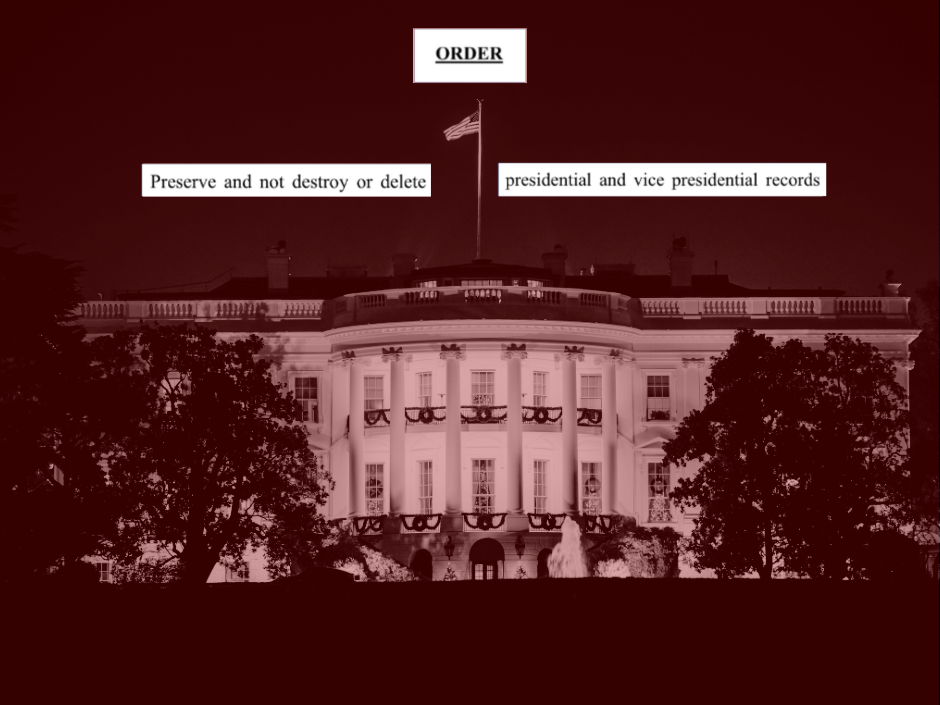
This week, a judge granted our emergency motion to make the Trump administration follow the Presidential Records Act.
We’ve been fighting for this since last month, when the Department of Justice’s Office of Legal Counsel (OLC) issued a sweeping opinion that the PRA is unconstitutional and claimed that Trump “need not further comply” with its requirements. That opinion threatened to block public access to hundreds of millions of records that could provide additional details on Trump’s corruption, conflicts of interest, and abuses of power.
We sued to defend the PRA, alongside the American Historical Association. We also filed a motion for a preliminary injunction to block the Trump administration from losing or destroying records.
On Wednesday, a federal judge granted that emergency order. The ruling requires the White House Office, the Department of Government Efficiency, and all advisers to the president to fully comply with the PRA. That includes preserving presidential and vice presidential records, and establishing records retention policies that are in full compliance with the law.
This is a huge win, and the fiery opinion is worth a read. (It opens with a George Orwell quote, and does not slow down from there.) But if diving into a sixty page legal document isn’t on your agenda for the holiday weekend, our Executive Director Chioma Chukwu put it in plain language: “Presidents do not get to decide unilaterally what history will remember and what the public will never see.”
We need answers about the Navy’s boat strike records
Last October, personnel aboard the USS Iwo Jima were reportedly told to delete photos and videos of two survivors taken into U.S. custody after a deadly boat strike in international waters. We asked the National Archives and Records Administration (NARA), the Department of Defense (DOD), and the Department of the Navy to investigate, since that could be a violation of the Federal Records Act. In March 2026, NARA told us there wasn’t enough proof to investigate further, and that the allegations in the reporting we cited were “insufficiently supported.”
Last week, we received a separate response from the Navy. In it, the Navy reiterated that NARA would be responsible for an investigation into deleted records, and noted that it is “unable to comment further due to a current ongoing investigation.” The fact that the Navy said there is an investigation is new information. This week, we sent another letter to NARA demanding that the agency take immediate action to determine whether destruction of records occurred, to prevent any further destruction, and to initiate action with the Attorney General to recover any records that were unlawfully removed.
“Federal agencies cannot simply make potentially damning records disappear and expect the public to accept silence in return,” said our Executive Director Chioma Chukwu. “The public deserves to know whether records were destroyed, who ordered it, and whether the government is meeting its legal obligations to preserve evidence of actions carried out in the public’s name.”
American Oversight in the news
- Federal judge orders White House offices to comply with Presidential Records Act (Washington Post)
- Judge halts White House’s rollback of presidential records-retention policies (CNN)
- White House officials must comply with Presidential Records Act (Bloomberg Law)
Other stories we’re following
- Agencies won’t hand over records for an investigation into how DOGE accessed data (Washington Post)
- IRS to drop audits of Trump and family (New York Times)
- Jan. 6 police officers sue to block Trump’s ‘anti-weaponization fund’ (Politico)
- Doctors say woman in El Paso ICE detention center urgently requires surgery that she is being denied (Texas Tribune)