Featured Documents
February 5, 2025
Georgia State Election Board Communications with Anti-Voter Groups and Individuals
attacks on educationGeorgia
Partisan forces — from local officials to the Trump administration — are threatening elections in the state.
Leading up to the 2026 midterm elections, President Donald Trump has been trying to settle old scores and to tip the scales in future races. These efforts have relied, at least in part, on claims about noncitizen voting and debunked conspiracy theories about the 2020 election.
Across the country, election administration is being reshaped in ways that give election deniers more control over how elections are run. Officials aligned with Trump’s election agenda now have more power over voting rules, voter rolls, early voting, ballot handling, investigations, and certification. These officials are using their control over election offices and records to restrict voting, disrupt election administration, sow doubt about valid election results, and open the door even wider to federal intervention in state and local elections — at times in direct coordination with the Trump administration.
The mechanics differ by state. Below, we lay out our biggest concerns in Georgia, and what we are doing to fight back.
This is part of a series. Read more about our investigations in North Carolina and Arizona.
In Georgia, partisan actors have expanded and shifted powers that were historically held by governors and nonpartisan election officials. That has undermined elections in the state in key ways.
Since returning to the White House, President Trump has continued to push false theories of voter fraud in Georgia.
In January 2026, the Federal Bureau of Investigations (FBI) seized reams of sensitive 2020 voting records from an election center in Fulton County — the state’s most populous county, which has a large percentage of voters of color — as part of the administration’s ongoing investigations into fraud claims. Georgia U.S. Sen. Raphael Warnock called the raid “pretext” for Trump to interfere in the state’s midterm elections.
In April 2026, the Department of Justice (DOJ) obtained a grand jury subpoena for the names and personal contact information of 2020 Fulton County employees and volunteer poll workers. A federal judge blocked that effort in July.
Some Georgia state lawmakers have cooperated with DOJ or the FBI, and may continue to do so if federal officials seek additional ballots, voting equipment, voter data, or election records. Some Georgia officials may even go as far as to invite federal interference.
The Georgia State Election Board (SEB) historically worked with the secretary of state’s office to oversee the state’s election processes. In recent years, Georgia’s Republican-controlled legislature shifted election oversight authority further away from the secretary of state and to the SEB. In 2021, Georgia’s legislature eliminated the secretary of state’s oversight of the SEB and gave the SEB more power to interfere in elections and challenge their results. In 2024, it ousted the secretary of state from the SEB entirely.
In recent years, the SEB has almost always been majority-led by Trump supporters who reject the results of the 2020 election. From his 2024 campaign trail, Trump praised three of his allies who were then members of the board — Janice Johnston, Janelle King, and Rick Jeffares — as “pit bulls” fighting for “victory.” Those members used their roles to attempt to change the state’s election rules, including by introducing unnecessarily burdensome voter identification laws, changing ballot counting procedures, and making it easier for election officials to delay certifying results.
In July 2024, Johnston, King, and Jeffares held a meeting to advance new election rules ahead of the general election, without legally required public notice or a quorum. During that meeting, the SEB advanced proposals that would have required counties to post certain election results that the secretary of state’s office already provided and to provide poll watchers greater access to ballot processing. The Georgia Supreme Court permanently rescinded the rules in June 2025, ruling that the SEB overstepped its authority and infringed on legislators’ lawmaking power.
Members of the SEB have also pushed for federal investigations into Georgia’s elections in efforts to justify taking over local election administration. In September 2026, Republican members of the SEB adopted a resolution asking the Trump administration to assist in a vague attack on the state’s voting system, just weeks before the election. Both Johnston and King were also cited as witnesses in the affidavit justifying the FBI’s Fulton County raid. In early 2026, three Trump-aligned members of the SEB — Johnston, King, and Salleigh Grubbs — filed an amicus brief in Pitts v. United States in support of the Trump administration’s seizure of 2020 election-related materials in Fulton County. That filing appears to present the three members’ positions as if they reflect those of the board itself, despite having no public vote or deliberation.
Johnston resigned from the SEB in June 2026. She was replaced by Carolyn Roddy, who was nominated by the state Republican party, leaving the board’s Republican majority intact.
Georgia has recently enacted laws that make it harder for many to vote. In 2021, the state legislature passed Senate Bill 202 (S.B. 202), a restrictive voting law that overhauled how elections work in the state. S.B. 202 shortened the time voters have to request and return mail-in ballots, introduced new voter identification requirements, and restricted ballot drop-box hours and locations. It also introduced new mail-in ballot counting procedures and deadlines and gave partisan actors greater access to those processes. Additionally, it banned anyone from handing out water or snacks to people waiting to vote — a provision that voting rights organizations challenged in court. A federal judge allowed the ban to be implemented in June 2026.
Officials have also considered laws that would change how voter registrations are maintained in the state. Georgia is a member of the Electronic Registration Information Center (ERIC), a nonpartisan voter-list maintenance system. The Georgia legislature has recently considered bills that would require it to leave ERIC, and the SEB has met with conservative activists promoting problematic software tools as alternatives to challenge and cancel the registrations of people they suspect are ineligible to vote.
In 2024, the state enacted a law that makes it easier for Georgians to baselessly challenge their neighbors’ voting eligibility using unreliable data.
Georgia’s 2026 elections will have an outsized national impact: The state’s U.S. Senate race — in which Trump-endorsed Rep. Mike Collins is challenging incumbent Sen. Jon Ossoff — has the potential to shift the balance of power in the Senate.
The changes Georgia has made to its election processes open the door to partisan election interference and challenges, certification delays, and issues with maintaining accurate and fair voter rolls. The SEB’s attempts to change election rules could also lead to confusion among election administrators in the state, which could delay future results and create dangerous opportunities for bad actors to sow distrust in elections. In addition, Georgia’s law allowing citizens to file an unlimited number of voter registration challenges increases the chances that eligible voters will have their registrations canceled or suspended based on inaccurate information. Since S.B. 202 was enacted, more than 63,000 voter registration challenges have been filed in the state, many in counties with high concentrations of non-white voters. A 2024 audit of Georgia’s voter rolls found that only 20 of its 8.2 million registered voters were non-citizens, none of whom voted in the 2024 election.
At the same time, these changes have imposed unnecessary barriers to vote that put voters of color, older voters, disabled voters, and others at heightened risk of disenfranchisement. During the 2024 election, 1.6 million registered voters in Georgia faced increased barriers because of S.B. 202, with Black voters and other voters of color facing the largest impact. Groups that face the most obstacles to vote are less likely to see their opinions represented and are more likely to be harassed or intimidated when trying to participate, contributing to further distrust in the election system.
The impact of partisan actions in Georgia would be even more pronounced when combined with similar actions in other states. In North Carolina, for example, partisan actors have shifted authority over county election procedures, ballots, voting systems, and records to the state’s Trump-aligned auditor. In Arizona, election deniers who have been placed in positions of authority at the county level have reduced early voting locations or ballot drop boxes, tightened signature-review rules, and made it more difficult to fix mail-in ballot problems.
American Oversight has been using public records requests and litigation to investigate these efforts to undermine the election process in Georgia. Our work has shed light on the tactics officials are deploying ahead of the 2026 election — and on the Trump administration’s years-long efforts to invalidate Georgia’s 2020 election results.
We’ve submitted multiple public records requests to learn more about the Trump administration’s ongoing efforts to investigate Georgia’s 2020 election. Following the FBI’s raid of the Fulton County elections office in January 2026, we filed a Freedom of Information Act (FOIA) request for top FBI officials’ related communications with the White House and multiple county election officials. In March 2026, the FBI told us that it could not confirm nor deny whether those records exist.
We’ve also filed multiple public records requests for Georgia state legislators’ and election officials’ communications with election denial activists. In March 2026, we published records that show election officials in the state have met with election denial activists who were involved in efforts to overturn the 2020 results to discuss newer voter roll purge tools known as ELLY and Psephos.
In 2025, we sent the Georgia secretary of state’s office a public records request for its communications about the state legislature’s efforts to withdraw from ERIC. We requested the office’s communications about alternative voter list maintenance systems or cross-state voter data-sharing agreements. Also in 2025, we filed a request for Laurens County’s election administration budget, which could help identify gaps in funding and advocate for racial and economic equity in election funding.
In April 2026, we sent a demand letter calling on three Trump-aligned members of the SEB to publicly address their amicus brief supporting the Trump administration’s seizure of 2020 election-related materials in Fulton County. The letter raised concerns that the members may have gathered outside of a properly noticed public meeting regarding the brief, in potential violation of the state’s Open Meetings Act, and that the letters raise the appearance of impropriety by taking a stance as the SEB without the agreement of other members.
We’ve also filed multiple public records requests for SEB members’ communications with election denial activists and about the board’s voter suppression efforts. In 2025, after the SEB hired an election denial activist with a history of challenging individuals’ voting eligibility to investigate claims of alleged voter fraud in Georgia, we requested all of the investigator’s documents, reports, and communications about the alleged fraud and voter eligibility challenges. In March 2025, the SEB told us that it had no records responsive to our request.
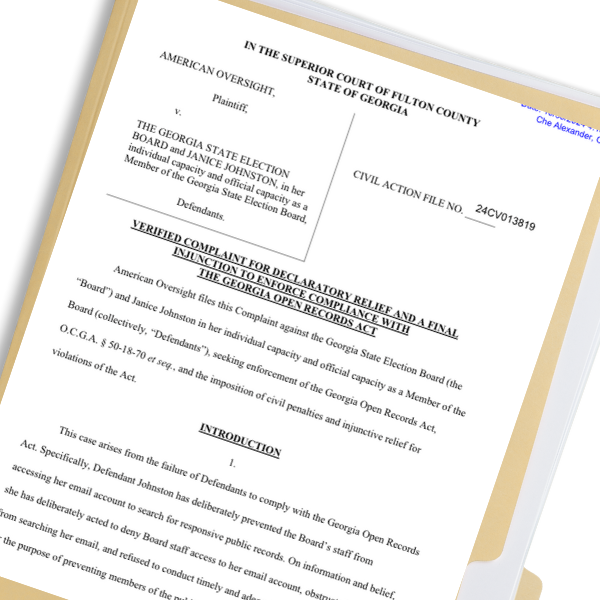
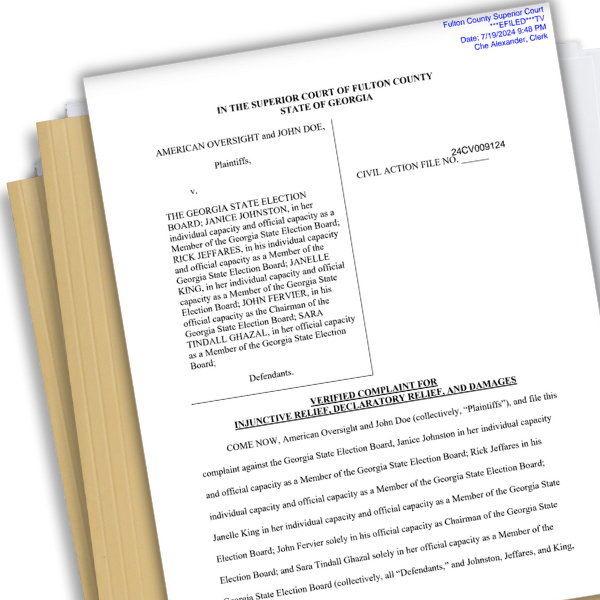
Additionally, we’ve filed multiple lawsuits to hold the SEB and several of its Trump-aligned members accountable. In 2025, we reached a settlement in our public records obstruction lawsuit against SEB and its then-member Janice Johnston, which requires SEB members to conduct official business only using official government accounts and to keep records of their official communications. That same year, the Georgia Republican Party intervened in and moved to dismiss another of our lawsuits against the SEB, which challenged members’ improperly noticed meeting to advance new election rules ahead of the 2024 election. We appealed the dismissal, and in October 2025 the Georgia Court of Appeals ruled in our favor, overturning the ruling.